

AI is changing how people search for information, discover businesses, and evaluate their options. As search engines and AI platforms become more conversational, traditional rankings are no longer the only way for brands to gain visibility.
AI SEO helps businesses appear in AI-generated answers, earn citations, and become trusted recommendations.
This statistical roundup brings together key AI SEO statistics covering AI search, Google AI Overviews, zero-click searches, citations, GEO, AEO, AI agents, and brand visibility. For reference, we have attached all the data sources at the end.
Here are the key AI SEO statistics
- AI search demand grew 3.6x since 2022.
- ChatGPT gets 6.12 billion monthly visits.
- AI Overviews reach 2+ billion monthly users.
- 80% to 83% of AI Overview searches end without a click.
- AI Mode has a 93% estimated zero click rate.
- Google and AI citations overlap by only 17% to 38%.
- AI agent searches grew nearly 22x from 2023 to 2026.
- 40.88% of businesses were never recommended by ChatGPT.
- Highly recommended businesses averaged 304 reviews, versus 117.5 for businesses never recommended.
- 74.6% of highly recommended businesses appeared in the Local Pack, versus 21.1% of businesses never recommended.
AI Search Adoption and Market Growth Statistics
AI search is growing rapidly, changing how people discover information and creating a new visibility channel for SEO teams.
- AI search demand grew 3.6x since 2022, reaching 326.9 million searches in the 12 months ending May 2026. The growth shows that AI-driven discovery is becoming a major part of search behavior, making AI SEO increasingly important for brands.
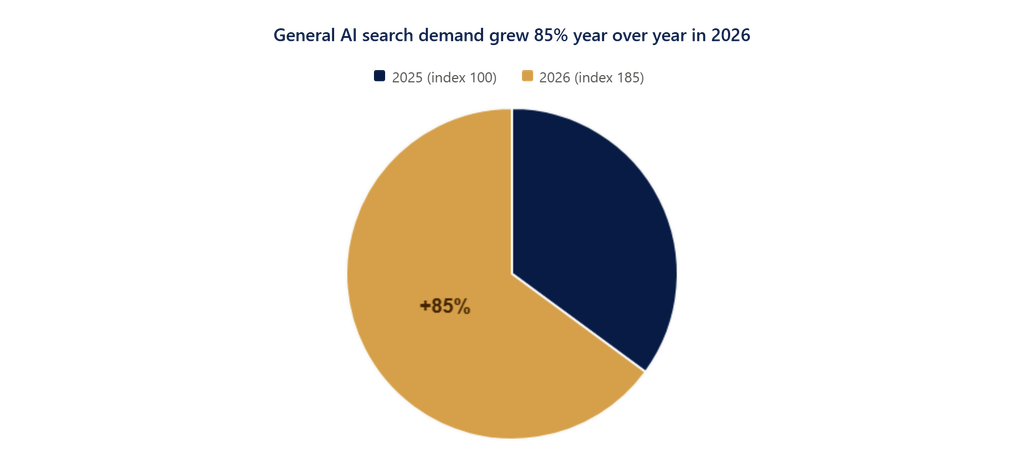
- General AI search demand increased 85% year over year in 2026, showing that users are rapidly adopting AI platforms to find information. Businesses can use AI SEO to improve their chances of appearing during this shift in search behavior.
- SEO related search demand fell 30% year over year, declining from 47.7 million searches in May 2025 to 33.4 million in May 2026. The decline contrasts with AI search growth and highlights changing interest in search technology.
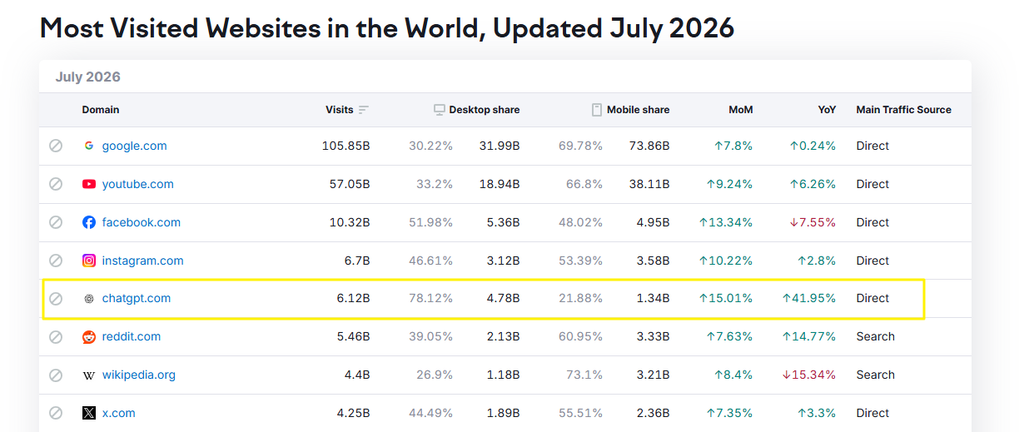
- ChatGPT received 6.12 billion monthly visits in 2026, making it the world’s fifth most-visited website. Its massive audience makes AI platforms an important discovery channel for businesses that want to expand visibility beyond traditional search engines.
- Gemini has more than 450 million monthly active users in 2026, with daily requests growing more than 50% from Q1. Its scale gives businesses another major AI platform where content and brand visibility can influence discovery.
- Google AI Mode has more than 100 million monthly active users in the US and India, despite still being in rollout. Its adoption shows why businesses need to consider AI visibility within Google alongside traditional organic rankings.
- Google processes more than 980 trillion monthly AI tokens across its products and platforms, up from 480 trillion announced in May 2025. The growth shows how deeply AI is becoming integrated into Google’s products and search ecosystem.
Google AI Overview Statistics
AI Overviews are changing Google Search by placing AI-generated answers directly within results, creating another surface where brands can earn visibility and citations.
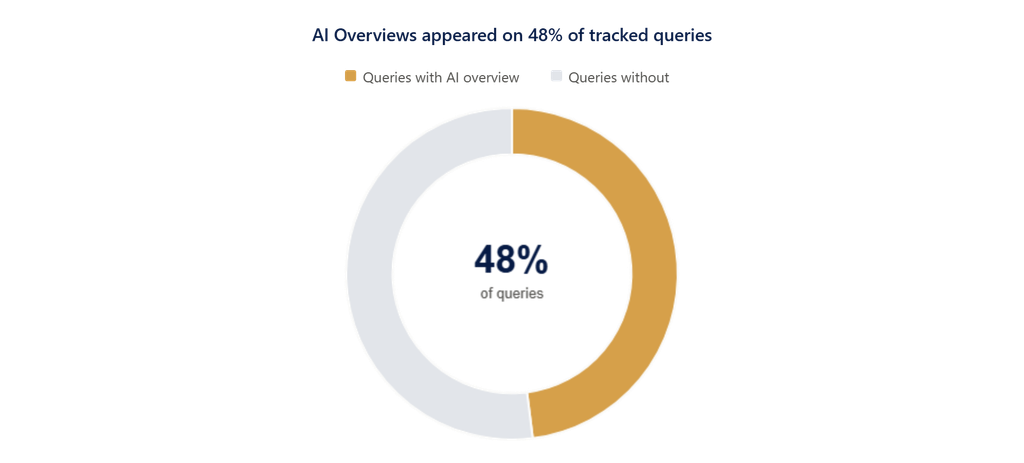
- AI Overviews appeared on about 48% of tracked queries, meaning nearly half of the searches in the dataset included an AI-generated answer. This gives businesses another search surface where AI SEO can influence brand visibility.
- AI Overviews reached more than 2 billion monthly users across 200+ countries and territories and 40 languages in 2025, showing that AI-generated search experiences have already achieved global reach and can affect SEO visibility across markets.
- AI Overviews drive more than 10% more queries globally for searches where they appear, suggesting that AI answers can increase search activity while changing how users interact with traditional organic results.
- 58% of US adults conducted at least one Google search that produced an AI-generated summary in March 2025, showing that AI search experiences have already reached mainstream users and now influence everyday search behavior.
- 18% of all Google searches produced an AI summary in March 2025, meaning AI-generated answers already affect a meaningful share of search activity and create another environment where businesses need to compete for visibility.
AI Search and Zero Click Statistics
AI-generated answers can satisfy search intent without requiring users to visit websites, making AI visibility, citations, and brand mentions increasingly important SEO outcomes.
- 80% to 83% of searches with an AI Overview ended without a click, showing how AI answers can satisfy users directly on the results page. AI SEO therefore needs to measure visibility within answers rather than focusing only on website traffic.
- AI Mode had an estimated 93% zero-click rate, showing how conversational search can keep users within the search interface. Businesses need AI SEO strategies that build brand visibility even when users do not visit their websites.
- AI-generated answers can reduce organic clicks by 38% to 60%, highlighting the potential traffic impact as search engines provide more direct answers. AI SEO can help businesses maintain visibility as traditional click opportunities decline.
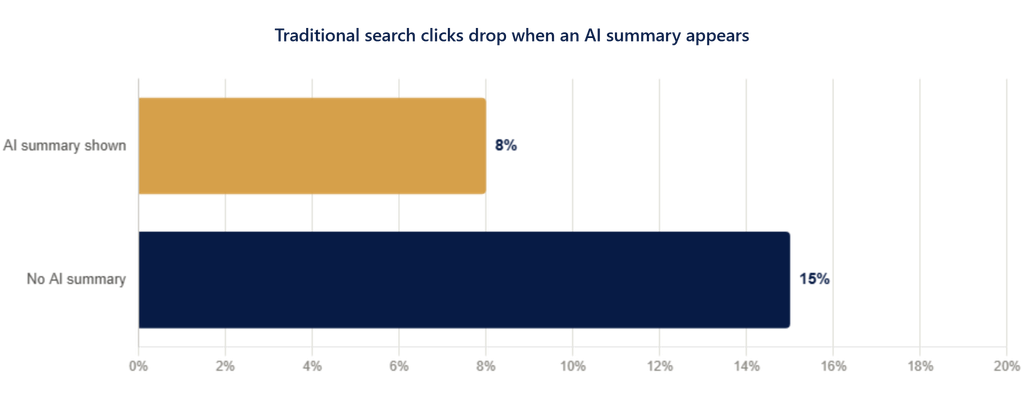
- Google users clicked traditional search results only 8% of the time when an AI summary appeared, compared with 15% when no summary appeared. This makes visibility within AI-generated answers increasingly valuable for businesses competing in search.
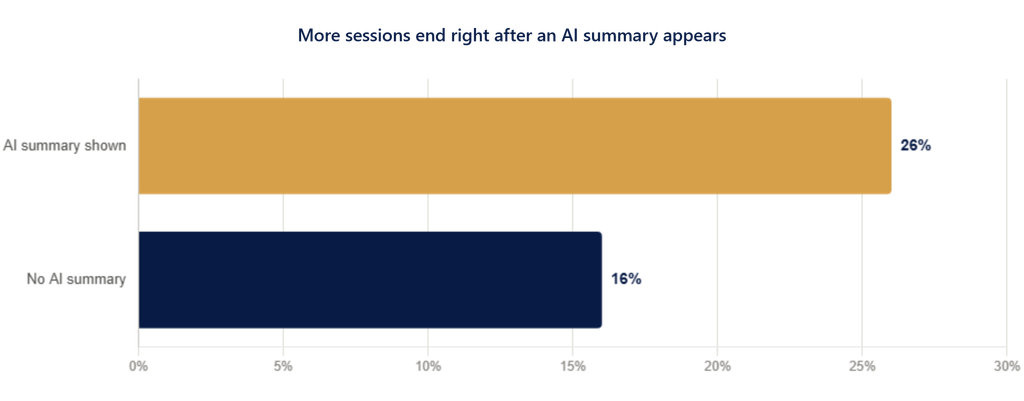
- 26% of visits to Google search pages with an AI summary ended the user’s browsing session, compared with 16% without one. AI answers can satisfy users earlier, reducing the need to continue browsing or visit additional websites.
AI Citation and Visibility Statistics
AI platforms use their own systems to select sources, meaning traditional Google rankings do not always determine which websites appear in AI-generated answers.
- The overlap between Google’s top 10 results and pages cited in AI answers fell from about 75% in mid 2025 to 17% to 38% by early 2026, showing that strong Google rankings do not automatically guarantee visibility in AI answers.
GEO, AEO and AI Agent Search Statistics
Growing search demand around GEO, AEO, and AI agents shows that marketers are adapting their strategies to new AI-driven discovery experiences.
- GEO search demand grew from virtually zero in 2023 to 59,800 searches in the 12 months ending May 2026, showing that interest in optimizing visibility across generative AI platforms has grown rapidly alongside AI search adoption.
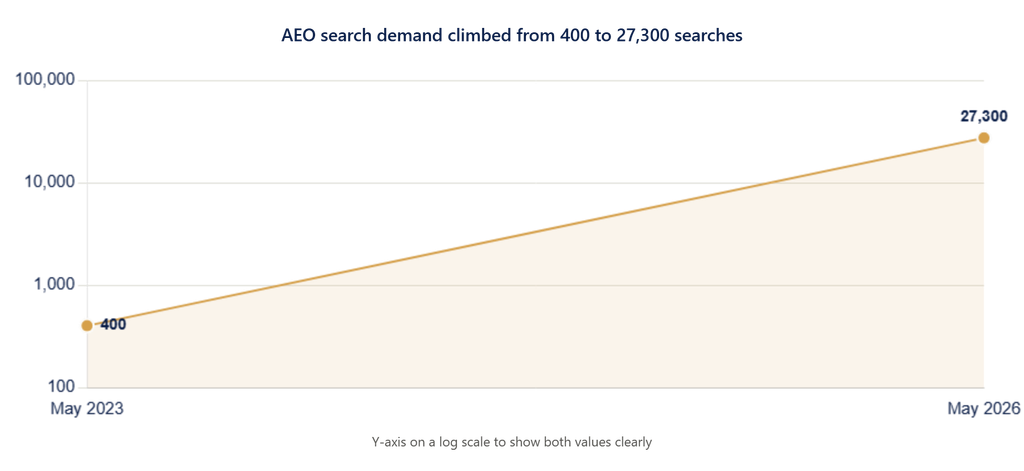
- AEO search demand increased from about 400 searches in the 12 months ending May 2023 to 27,300 searches by May 2026, showing growing interest in optimizing content so AI systems can understand and use information in generated answers.
- GEO had roughly twice the search volume of AEO in the 12 months ending May 2026, with 59,800 GEO searches compared with 27,300 AEO searches. This indicates stronger current search interest in generative engine optimization.
- AEO search demand was about 17% below its September 2025 peak by 2026, showing that interest had cooled from its highest level while remaining substantially above the demand recorded when AEO first emerged.
- GEO search demand was about 45% below its August 2025 peak by 2026, showing that interest has fluctuated despite substantial growth since 2023. SEO teams should therefore track AI search trends rather than assume steady growth.
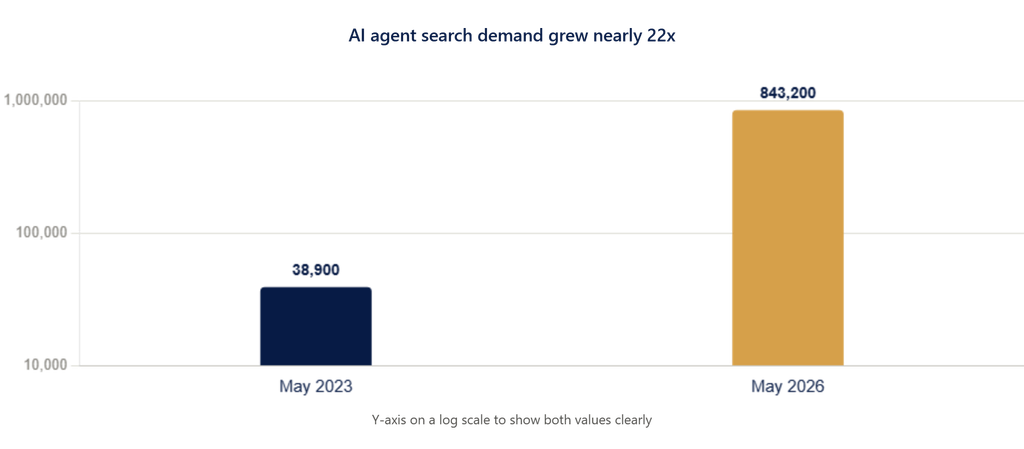
- AI agent search demand grew from 38,900 to 843,200 searches between May 2023 and May 2026, representing nearly 22 times growth. The increase suggests AI agents are becoming an important area for future search strategies.
- AI agent search demand peaked around early 2026 before falling about 40%, showing that interest in emerging AI search formats can change quickly. However, its longer-term growth still makes agent-based discovery relevant to AI SEO.
AI Business Discovery and Recommendation Statistics
For businesses, AI SEO is not only about appearing in answers. Being recommended when users ask AI platforms which company or service they should choose can have greater commercial value.
- ChatGPT identified 93.59% of businesses, compared with 93.15% identified by Perplexity, showing that most businesses achieved basic AI discoverability. However, being identified is different from being recommended, making recommendation visibility an important AI SEO metric.
- 40.88% of businesses were never recommended by ChatGPT, even though the platform identified most businesses. This gap shows that AI SEO needs to build relevance, authority, reputation, and supporting signals beyond basic brand recognition.
- Perplexity never recommended 68.79% of businesses, creating an even larger gap between identification and recommendation. Businesses therefore need a strong digital presence to achieve consistent recommendation visibility across different AI platforms.
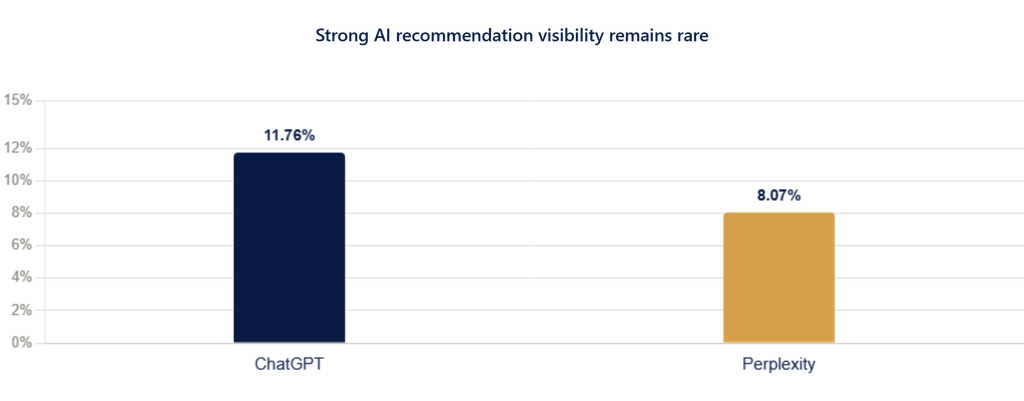
- Only 11.76% of businesses were highly recommended by ChatGPT, compared with 8.07% in Perplexity, showing how difficult it is to achieve strong recommendation visibility even when an AI platform can identify the business.
AI Reputation and Local SEO Statistics
The data connects AI recommendations with traditional local SEO signals, suggesting that reviews, rankings, business profiles, and directory presence can contribute to stronger AI visibility.
- ChatGPT rated 37% of businesses as very positive and 42.8% as positive, meaning nearly 80% received a positive or very positive assessment. Strong brand reputation can therefore influence how AI systems evaluate businesses.
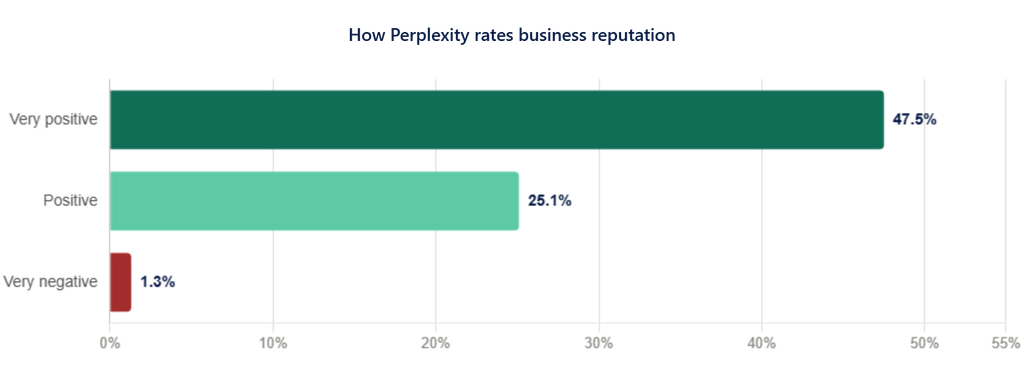
- Perplexity rated 47.5% of businesses as very positive and 25.1% as positive, while only 1.3% received a very negative rating. These differences show why businesses should monitor how multiple AI platforms assess their brand reputation.
- Only 0.5% of businesses received a very negative ChatGPT rating, showing that extremely negative assessments were uncommon in the tested dataset. Maintaining accurate information and a strong reputation can still support how AI systems perceive a business.
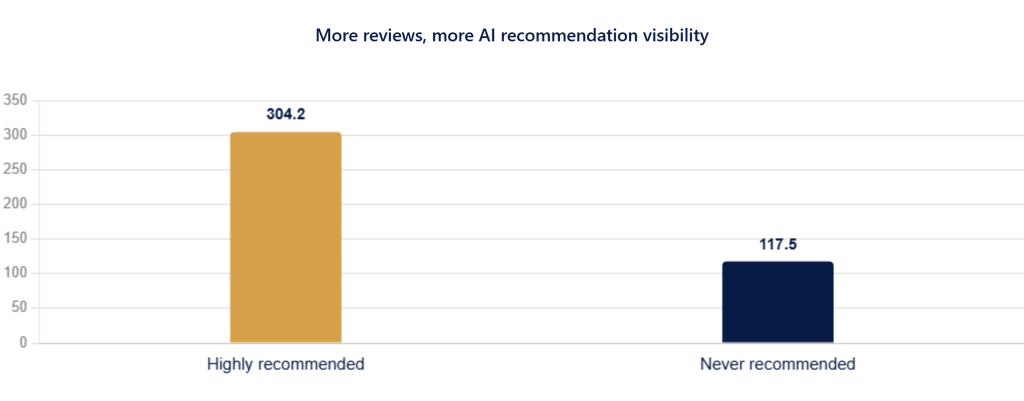
- Highly recommended businesses averaged 304.2 reviews, compared with 117.5 reviews for businesses never recommended, showing a strong association between review volume and AI recommendation visibility. Reviews can provide important third-party reputation signals for AI systems.
- 74.6% of highly recommended businesses appeared in Google’s Local Pack, compared with 21.1% of businesses never recommended. The relationship suggests that strong local search visibility can support the broader signals used in AI recommendations.
- 92.5% of highly recommended businesses ranked for target keywords, compared with 48.1% of businesses never recommended. Traditional keyword visibility still appears relevant, showing that AI SEO builds on strong foundational SEO rather than replacing it.
- 82.5% of highly recommended businesses had complete Google Business Profiles, compared with 68% of businesses never recommended. Complete, accurate business information gives AI systems stronger signals for understanding local businesses.
- Highly recommended businesses averaged 12.6 directory listings, compared with 5.4 for businesses never recommended. A broader presence across trusted directories can strengthen the information ecosystem that AI systems use to evaluate businesses.
- About 80% of US consumers search for local business information at least once a week, showing strong ongoing demand for local discovery. As AI becomes another discovery channel, local SEO strategies increasingly need an AI visibility component.
- 19% of consumers use AI tools such as ChatGPT or Gemini to find local businesses, giving local businesses a direct reason to optimize their websites, profiles, reviews, and third-party presence for AI discovery.
Website and Content Statistics for AI Visibility
AI platforms rely on company websites and third-party sources to understand businesses, so a strong, consistent digital presence is a key part of AI SEO.
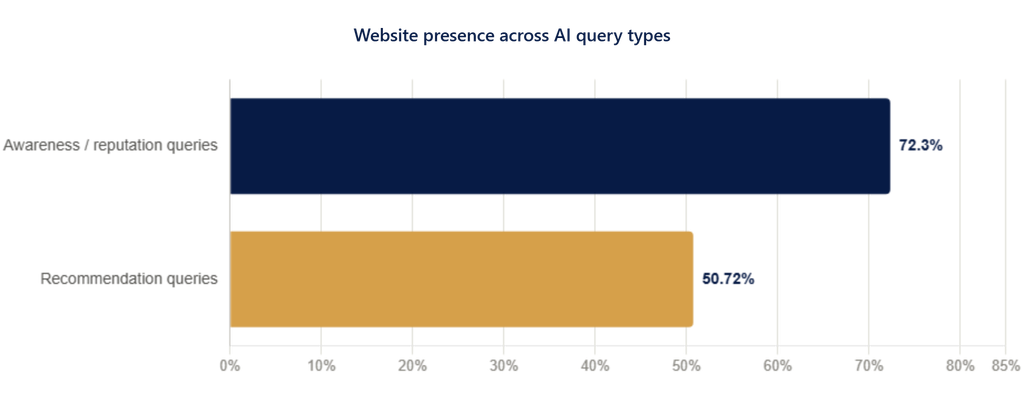
- Business websites appeared in 72.3% of awareness and reputation queries and 50.72% of recommendation queries, making a clear, authoritative website an important foundation for AI search visibility and brand discovery.
- Directory and listing sites appeared in 38.85% of awareness and reputation queries and 35.25% of recommendation queries, showing that AI SEO extends beyond a company’s website and requires consistent information across important third-party sources.
- Review sites appeared in 1.8% of awareness and reputation queries but 11.51% of recommendation queries, suggesting that third-party reputation sources become more important when AI systems help users compare businesses and make decisions.
- Trade websites appeared in 10.07% of awareness and reputation queries and 23.02% of recommendation queries, showing that industry-specific third-party sources can become more important when AI systems evaluate businesses for recommendations.
- Highly recommended businesses averaged 959 words per page, compared with 696 words for businesses never recommended, suggesting that detailed content gives AI systems more context about services, expertise, relevance, and business offerings.
Technical SEO and AI Visibility Statistics
Technical SEO remains important for website quality, but the data shows weaker relationships between technical signals and AI visibility than broader content, reputation, rankings, and business presence.
- Core Web Vitals passed for 1.9% of businesses found by both ChatGPT and Perplexity, compared with 1.1% of businesses not found. The small difference suggests technical performance alone does not explain AI visibility.
- Overall website performance scores showed no meaningful relationship with AI visibility, suggesting that improving technical performance alone may not be enough to make a brand more visible or more frequently recommended by AI platforms.
- 76.5% of highly recommended businesses had structured data, compared with 69.6% of businesses never recommended. The difference suggests a possible relationship with AI visibility, although structured data should not be treated as a proven AI ranking factor.
- 35.1% of highly recommended businesses had an llms.txt file, compared with 27.5% of businesses never recommended. The difference suggests a possible relationship, but it is not enough to establish llms.txt as a proven AI SEO ranking factor.
Final Words
The numbers make one thing clear: AI is changing how search visibility works. Brands can no longer rely only on traditional rankings when users increasingly discover businesses through AI-generated answers.
This is where ASAD can help. Its AI SEO services help UAE businesses improve visibility across ChatGPT, Google AI Overviews, Perplexity, Gemini, and other AI platforms through GEO, content, technical SEO, digital PR, and authority building.
Start with a free 48-hour AI visibility audit to see where your brand stands.
Data Sources
- https://www.rankability.com/assets/where-seo-is-going-2026.pdf
- https://irp.cdn-website.com/548ed645/files/uploaded/The+AI+Visibility+Report_+How+AI+Chooses+Local+Businesses-8.pdf
- https://blog.google/company-news/inside-google/message-ceo/alphabet-earnings-q2-2025/
- https://www.semrush.com/trending-websites/global/all/
- https://blog.google/company-news/inside-google/message-ceo/alphabet-earnings-q2-2025/
- https://www.pewresearch.org/short-reads/2025/07/22/google-users-are-less-likely-to-click-on-links-when-an-ai-summary-appears-in-the-results/