



As buyers increasingly turn to AI tools to discover and compare software, appearing in one platform’s recommendations may not guarantee visibility in another.
We wanted to test whether Google AI Overviews and ChatGPT recommend the same brands for identical commercial search queries.
We hypothesized that both platforms would share some leading SaaS brands but produce noticeably different shortlists and top recommendations. To test this, we compared their top five brand recommendations across 50 prompts covering 10 SaaS categories.
Methodology
The methodology covered the following steps:
- Prompt selection: Created 50 commercial prompts across 10 SaaS categories, with five prompts per category. Each followed the format “Share 5 best [category] for [audience]” to reflect real software discovery and buying searches.
- Google AI testing: Searched all 50 prompts on Google.com on 11 November 2026, with India set as the search location. Recorded the first five brands shown in each AI Overview.
- ChatGPT testing: Submitted the same 50 prompts to ChatGPT on the same date. Used a signed in account and a separate fresh chat for each prompt to avoid context from earlier queries.
- Data collection: Recorded the first five brand recommendations from each platform in their original order.
- Brand matching: Used exact brand name matching to identify shared recommendations. Different names, such as Zoom and Zoom Workplace, counted as separate entries.
- Overlap calculation: Counted shared brands in each prompt and calculated the overall overlap across all comparable results.
- No. 1 comparison: Compared the first recommended brand from Google AI with the first recommended brand from ChatGPT for each prompt.
- Missing results: Google AI did not show an AI Overview for two prompts. We excluded these from the comparison, leaving 48 prompts with results from both platforms.
👉 Access the raw data here: AI Overviews vs. ChatGPT — Top 5 Brands per Prompt • SaaS only • 50 prompts | BY ASAD
Key findings at a glance
- Google AI and ChatGPT shared 61% of their brand recommendations, with both platforms recommending an average of 3 of the same 5 brands across 48 comparable prompts.
- Both platforms selected the same No. 1 brand in only 22 out of 48 prompts (46%), showing that their top recommendations often differed.
- Brand overlap varied from 36% to 73% across SaaS categories. Customer support had the highest overlap at 73%, while HR and payroll had the lowest at 36%.
- Both platforms recommended at least 3 of the same 5 brands in 35 out of 48 prompts (73%).
- Out of 220 unique companies, 125 appeared on only one platform. Google AI recommended 62 exclusive companies, while ChatGPT recommended 63.
- Google AI did not show an AI Overview for 2 of the 50 prompts, while ChatGPT provided recommendations for all 50.
These findings are based on our test of 50 commercial prompts across 10 SaaS categories on 11 November 2026.
1. Google AI and ChatGPT share 61% of their brand recommendations
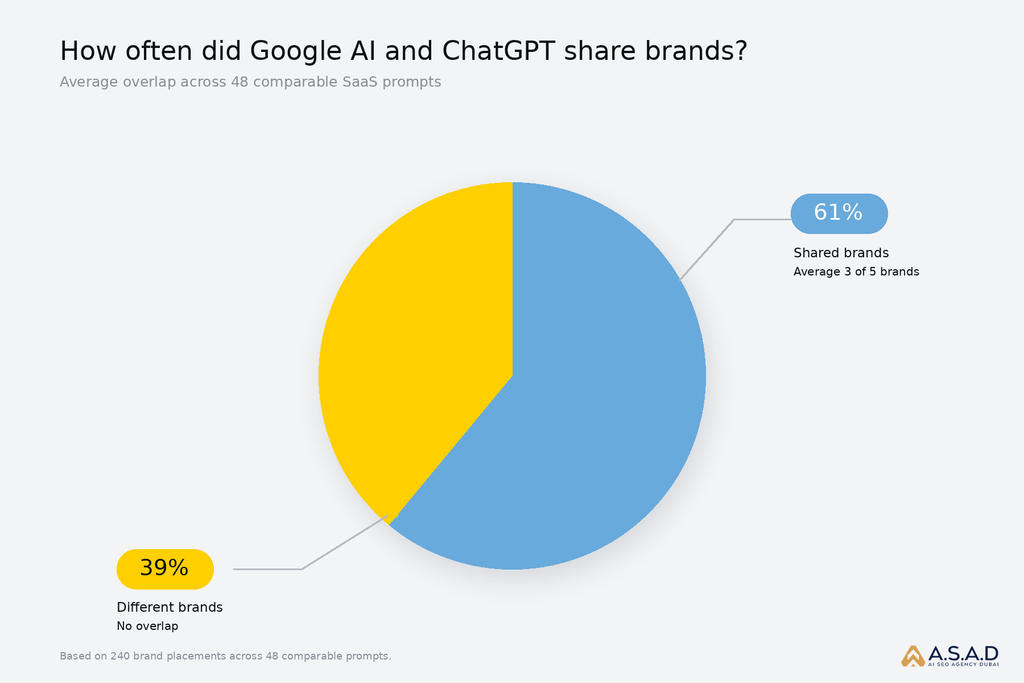
Google AI and ChatGPT recommended an average of 3 out of the same 5 brands across 48 comparable prompts, resulting in 61% overlap. Out of 240 possible shared brand placements, both platforms included the same brands in 146 placements.
This means Google AI and ChatGPT draw from a largely shared set of SaaS companies when answering commercial search queries. However, their recommendations are not identical. A company that appears in Google’s AI Overview may not necessarily appear in ChatGPT’s answer for the same query.
For SaaS brands, this means visibility in one AI platform does not guarantee visibility in another. Businesses need to monitor their brand recommendations across both platforms.
2. Google AI and ChatGPT selected the same No. 1 brand in only 46% of searches
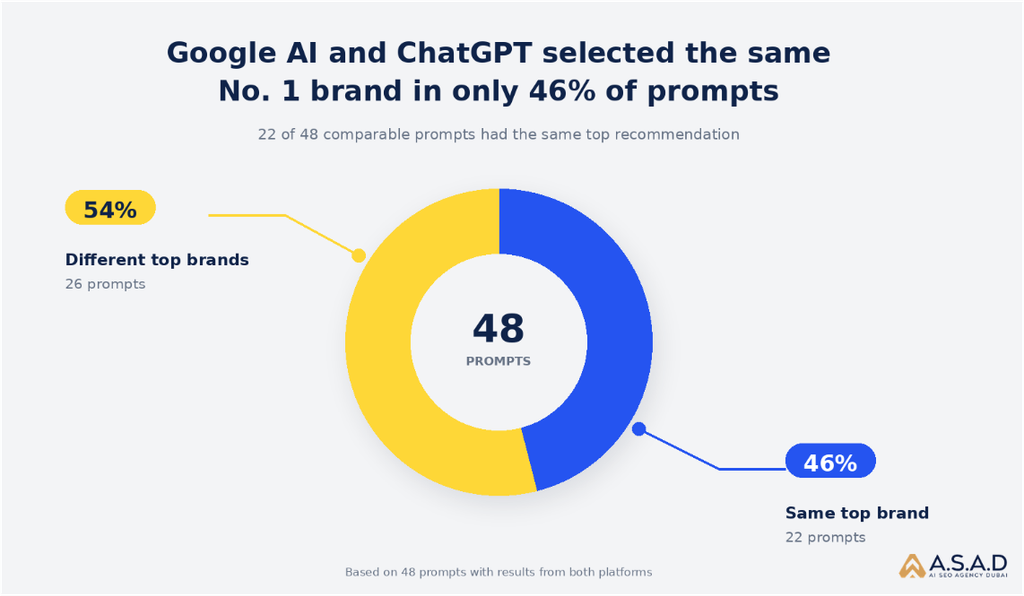
Google AI and ChatGPT selected the same No. 1 brand in just 22 of the 48 comparable prompts. In the remaining 26 prompts, each platform placed a different company at the top.
For example, Google AI placed Asana or Trello first in several project management searches where ChatGPT recommended ClickUp. In CRM searches, Google AI selected HubSpot as the top recommendation in three of five prompts, while ChatGPT selected Zoho for the small business prompt.
This shows that appearing in both AI search results does not guarantee the same recommendation position. A brand may feature in both answers but lose the top spot in one of them. Businesses should track their recommendation position, not just whether their brand appears.
3. Brand overlap varies from 36% to 73% across SaaS categories
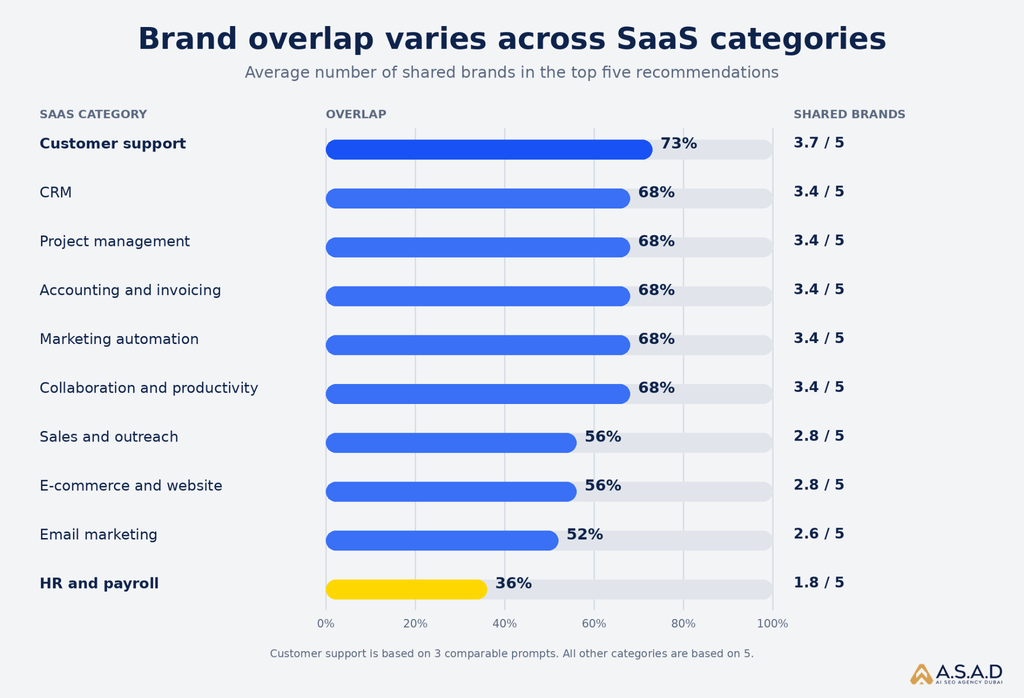
Customer support had the highest overlap between Google AI and ChatGPT at 73%, while HR and payroll had the lowest at 36%. The other categories recorded overlap rates between 52% and 68%.
| SaaS category | Average shared brands | Overlap |
| Customer support | 3.7 out of 5 | 73% |
| CRM | 3.4 out of 5 | 68% |
| Project management | 3.4 out of 5 | 68% |
| Accounting and invoicing | 3.4 out of 5 | 68% |
| Marketing automation | 3.4 out of 5 | 68% |
| Collaboration and productivity | 3.4 out of 5 | 68% |
| Sales and outreach | 2.8 out of 5 | 56% |
| E-commerce and website | 2.8 out of 5 | 56% |
| Email marketing | 2.6 out of 5 | 52% |
| HR and payroll | 1.8 out of 5 | 36% |
What this means:
Google AI and ChatGPT do not recommend SaaS brands at the same rate across every category. For example, a company selling HR or payroll software may face greater differences in recommendations than a company selling customer support software.
For marketers, this means AI visibility needs to be measured at the category and product level. A single overall visibility score may hide important differences in how Google AI and ChatGPT recommend brands for specific buyer needs.
Note: Customer support overlap is based on three comparable prompts because Google AI did not show an AI Overview for the other two.
4. Google AI and ChatGPT shared at least three brands in 73% of searches
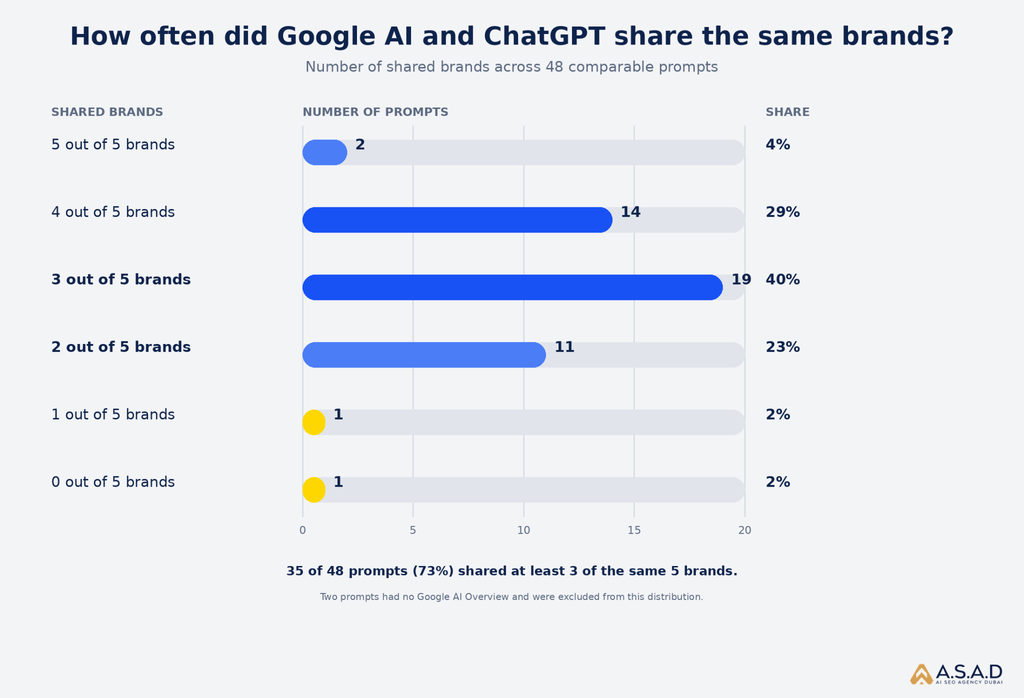
Out of 48 comparable prompts, Google AI and ChatGPT recommended at least three of the same five brands in 35 prompts. This means 73% of searches had an overlap of 60% or more.
The following table shows how often their recommendations matched.
| Shared brands | Number of prompts | Share of 48 prompts |
| 5 out of 5 (100%) | 2 | 4% |
| 4 out of 5 (80%) | 14 | 29% |
| 3 out of 5 (60%) | 19 | 40% |
| 2 out of 5 (40%) | 11 | 23% |
| 1 out of 5 (20%) | 1 | 2% |
| 0 out of 5 (0%) | 1 | 2% |
| No Google AI Overview | 2 | Not included |
What this means
Although Google AI and ChatGPT usually agreed on most of their recommendations, they did not always return the same shortlist. In 13 of the 48 comparable searches, they shared fewer than three brands.
This means businesses may miss out on visibility when buyers use a different AI search platform. Even when both platforms recommend several established competitors, the remaining positions can introduce different companies to potential buyers.
The two prompts with no Google AI Overview were excluded from the overlap calculation. ChatGPT provided recommendations for both.
5. Google AI and ChatGPT recommended 125 unique companies that did not appear in both
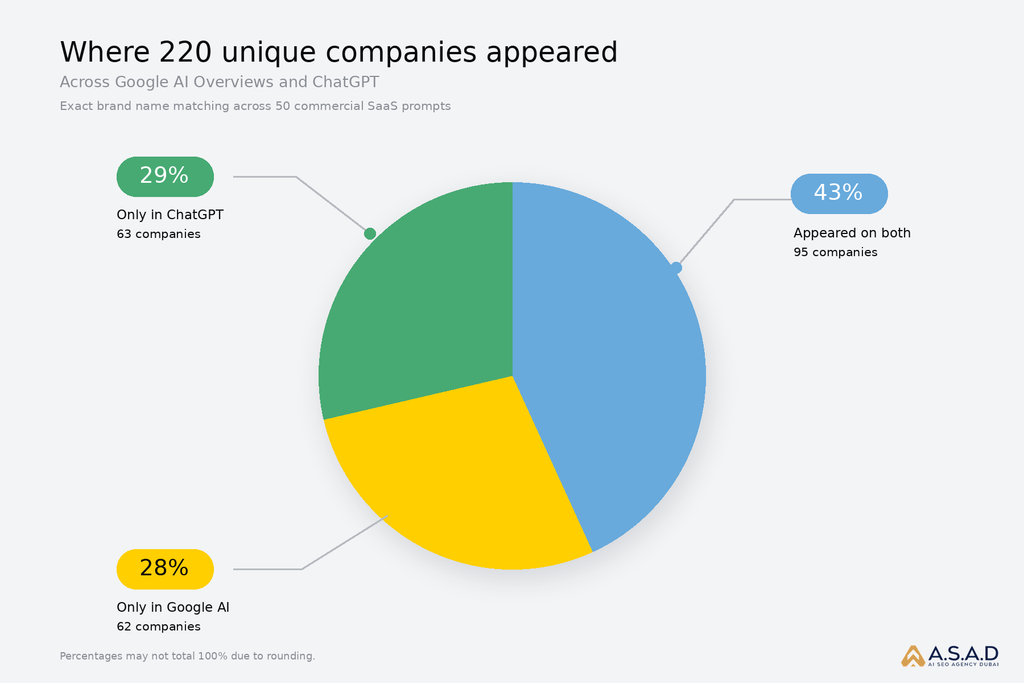
Across all 50 prompts, Google AI and ChatGPT named 220 unique companies. Of these, 95 appeared in both, while 62 appeared only in Google AI Overviews and 63 appeared only in ChatGPT.
| Brand appearance | Number of companies | Share of 220 companies |
| Appeared in both | 95 | 43% |
| Only in Google AI Overviews | 62 | 28% |
| Only in ChatGPT | 63 | 29% |
| Total | 220 | 100% |
What this means
This means that 125 of the 220 unique companies appeared in only one AI platform during the test. Google AI and ChatGPT each recommended more than 60 companies that did not appear in the other’s results.
For SaaS businesses, this highlights a visibility gap. A brand may already appear in Google’s AI Overviews but remain absent from ChatGPT recommendations, or the other way around.
Tracking brand mentions across multiple AI platforms can help marketers identify where competitors appear, where their own brand is missing and which platforms need more attention.
Note: These figures use exact brand name matching. Different names for the same company, such as Zoom and Zoom Workplace, were counted separately.
What the findings mean for SaaS brands and marketers
1. Measure visibility across more than one AI platform
A brand’s presence in Google AI Overviews does not confirm that ChatGPT will recommend it. The study found 62 companies that appeared in Google’s recommendations but did not appear in ChatGPT’s recommendations. The reverse was also true for 63 companies. Marketers should therefore check the same commercial prompts across more than one AI platform.
2. Track category level performance
Overlap ranged from 36% in HR and payroll to 73% in customer support. A single overall visibility score can hide these differences. SaaS companies should group their prompts by product category, audience and use case so they can see where their visibility is strong and where platforms return different competitors.
3. Track position as well as presence
A brand can appear in both platforms but hold different positions. Since the same No. 1 brand appeared in only 22 of 48 comparable prompts, marketers should record whether they appear, how often they appear and where they rank in each list.
4. Keep brand and product names clear and consistent
The study’s exact match method treated some naming variations as separate brands. Clear and consistent naming across a company’s website, product pages and public profiles can make it easier for readers and systems to connect references to the same company. This study did not test whether naming consistency causes higher AI visibility, so this should be treated as a practical consideration rather than a proven cause.
5. Repeat the test over time
AI generated answers can change. This study records what the platforms returned on 11 November 2026. It does not show whether the same recommendations will remain in place. Brands that use AI visibility as a performance measure should repeat the same prompts on a schedule and compare changes over time.
Test conditions and limitations
This study uses SaaS as its only reference industry, so the findings may not apply to other sectors. It also captures AI recommendations from a single day, which may change over time. We compared only the first five recommendations, not every brand mentioned. Finally, correlation does not imply causation. The overlap between platforms does not prove that the same factors influence their recommendations.
Final words
Google AI Overviews and ChatGPT share much of their SaaS recommendation pool, but they do not produce the same shortlist every time. The platforms shared three of their top five recommendations on average, selected the same No. 1 brand in fewer than half of comparable prompts and each surfaced more than 60 companies that the other did not name.
For SaaS brands, the main lesson is clear: AI search visibility should not be measured through a single platform. Marketers need to test the same commercial prompts across multiple AI tools, track both presence and position, and repeat the analysis to see how recommendations change.