



At ASAD, we’ve worked with 60+ brands across different industries, and SaaS SEO has taught us one thing: what looks good in an SEO report does not always translate into business results.
This guide is based on our firsthand experience of planning and executing SEO strategies for SaaS brands. We’ve seen what works, where SaaS SEO campaigns tend to go wrong, and which activities actually help turn organic search into qualified traffic, leads, and revenue.
So, rather than sharing a generic list of SaaS SEO tactics, this guide breaks down how we approach SaaS SEO in 2026, from keyword research and content updates to bottom-of-funnel pages, authority building, conversion, and AI brand positioning.
Before we start
SaaS SEO works best when the strategy connects search demand with your product, target customers, and revenue goals. If you want to build an SEO strategy around qualified traffic, commercial opportunities, and long-term organic growth, our SaaS SEO team can help.
Our SaaS SEO service is built around keyword intent, product and use case pages, content optimisation, internal linking, authority building, and AI brand positioning.
Want to see what SaaS SEO could do for your business?
What is SaaS SEO?
SaaS SEO is the process of improving a software company’s website and online presence so it can attract the right audience through search engines and turn that visibility into signups, demos, trials, and customers.
Unlike traditional SEO, SaaS SEO needs to account for the entire buying journey. That includes searches around problems, use cases, features, comparisons, alternatives, pricing, industries, and specific customer segments.
The focus is not simply on generating more organic traffic. A strong SaaS SEO strategy connects search demand with the product, target audience, and revenue goals. It also builds the brand’s authority across third-party sources and helps establish how the company is understood and positioned in AI search results.
Here are the SaaS SEO strategies that helped us generate results for clients like Yomly:
1. Start with the SaaS business model, not a keyword list
The first step is understanding the business, not opening an SEO or keyword research tool. Start with the ideal customer, deal value, sales cycle, product use cases, problems, buying triggers, and what makes someone a qualified customer.
Audience research can add another layer here. In fact, real conversations on Reddit, Quora, forums, reviews, and other communities reveal how potential customers describe their problems and what they are actually trying to solve. Keyword research can then validate search demand around those problems.
A SaaS company can rank for thousands of keywords and still generate little revenue if those searches come from the wrong audience. Map the customer journey first, then connect search demand to each stage.
Here’s a typical audience research process we follow at ASAD:
- Step 1: Find where your audience talks
Search Reddit, Quora, YouTube, forums, reviews, and other communities for real discussions about your topic. - Step 2: Collect real questions
Save questions that reveal problems, concerns, goals, or gaps in knowledge. Read the answers and comments to understand the context. - Step 3: Build an audience research sheet
Record each question, source, and URL. Add the problem and topic once you start seeing patterns. - Step 4: Identify the problem behind each question
Look beyond the question. Understand what the person wants to achieve, what is stopping them, and what information they need. - Step 5: Use AI to find patterns
Group questions by intent, such as informational, comparison, troubleshooting, and pricing. Find repeated phrases and question patterns.
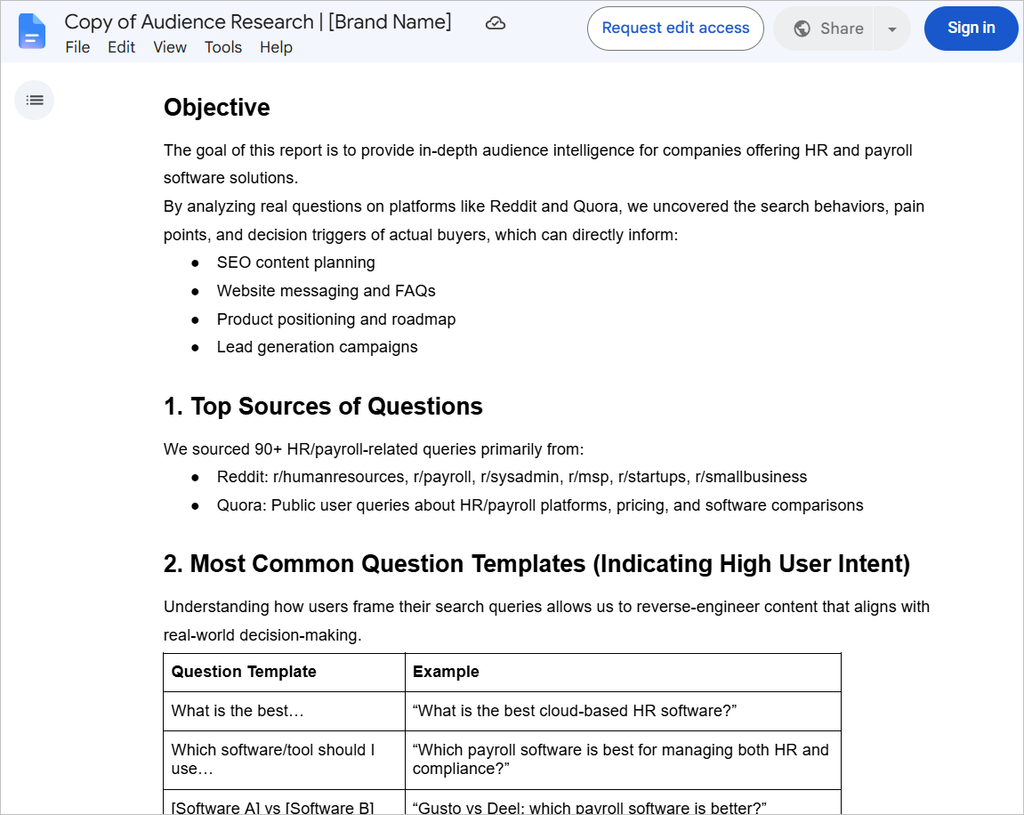
Here, you can preview one of our audience research report summarized by ChatGPT →
- Step 6: Validate with keyword research
Use SEO tools to check search demand, competition, and related queries. Use keyword data to validate your findings, not to define your entire strategy. - Step 7: Map insights to content
Connect each question cluster to a keyword template, search intent, and the specific page or article that should answer it.
This makes it easier to decide which opportunities need product pages, use case pages, comparison content, educational articles, or conversion focused landing pages.
2. Build the keyword strategy around intent, use cases, and buying moments
A SaaS keyword strategy should not rely on search volume alone. Map keywords to intent so it’s clear which searches influence awareness, consideration, or revenue.
Commercial and bottom-of-funnel searches deserve particular attention. The SERP also needs to be reviewed before creating a page because search intent can change over time.
| Search intent | Example query | Recommended page | Primary goal |
| Informational | how does payroll software work | Educational guide | Build awareness |
| Problem aware | how to reduce payroll errors | Problem focused guide | Create demand |
| Use case | payroll software for remote teams | Use case page | Capture qualified demand |
| Commercial | best payroll software | Comparison page | Drive consideration |
| Competitive | alternatives to [competitor] | Alternative page | Capture active buyers |
| Product | enterprise payroll software | Product page | Drive product interest |
| Pricing | payroll software pricing | Pricing page | Support evaluation |
| Bottom of funnel | payroll software for 500 employees | Solution page | Convert qualified buyers |
The goal is not to rank for every relevant keyword. It is to build a keyword portfolio where each page has a clear role in the buying journey. We would give greater priority to searches that connect directly to the product, target customer, and revenue opportunity.
3. Build pages for the customers you actually want
Traffic does not automatically translate into business value. Page creation should follow the sales strategy, with content built around relevant industries, company sizes, locations, and use cases.
This includes bottom-of-funnel pages that may have limited SEO value but strong conversion value. Their role is to answer objections, support sales conversations, and help qualified visitors make a decision.
| Page type | Example | SEO value | Conversion value |
| Customer segment | Payroll software for 500+ employees | High | High |
| Industry | Payroll software for healthcare | High | High |
| Use case | Payroll software for remote teams | High | High |
| Alternative | Best alternative to [competitor] | High | High |
| Comparison | [Product] vs [competitor] | High | High |
| Sales enablement | Why companies switch to us | Low | High |
| Objection handling | Is the software secure for enterprises? | Low | High |
| Buyer specific | Payroll software for CFOs | Low | High |
| Feature decision | Automated payroll compliance | Medium | High |
| Custom solution | Enterprise payroll implementation | Low | Very high |
We would therefore judge these pages differently from traditional SEO content. A page does not need thousands of visitors to be valuable. If it helps a qualified prospect understand the product, overcome an objection, or move closer to a demo, it is doing its job.
4. Refresh the pages you already have before creating hundreds more
Before creating new content, review existing pages for rankings, impressions, traffic, and business value. If a SaaS site already has dozens of articles generating zero to negligible traffic or impressions, a quick content audit can identify these pages and create a cleanup list.
From there, prioritise pages that have lost traffic during the last three months, rank between positions 8 and 30, or have strong business value. This helps separate pages worth improving from content that may need consolidation, a different search intent, or removal.
| Signal | What we look for | Priority |
| Traffic decline | Organic traffic falling over 3 months | High |
| Positions 8 to 30 | Pages close to page one | High |
| Business value | Strong connection to products or buyers | Very high |
| Existing authority | Quality backlinks or strong internal links | High |
| High impressions | Demand but weak clicks | Medium |
| Low business relevance | Traffic unlikely to become customers | Low |
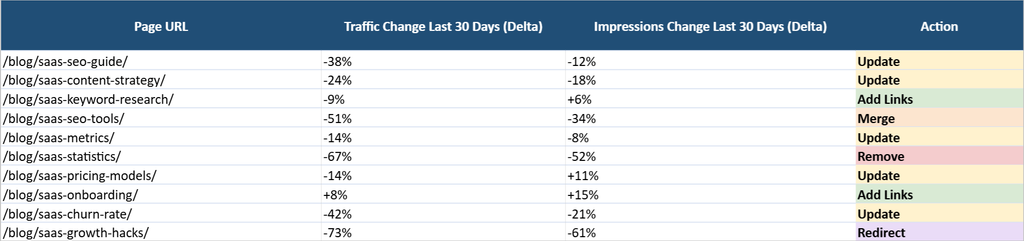
Here’s a Google Sheet template we use to take actions against low-performing or declining pages:
5. Make content easy for both search engines and AI systems to understand
Technical SEO remains important, but content clarity becomes even more important as search changes.
Important pages should have clear headings, logical structures, useful metadata, strong internal links, accessible content, and structured information where appropriate.
We would also make important product and company facts easy to extract. Instead of hiding key information inside vague marketing language, we would use clear statements that explain what the product does, who it serves, and what makes it different.
The reference highlights this difference between traditional keyword focused content and AI friendly content. AI systems benefit from natural language, clear answers, and declarative statements that they can understand and reuse.
6. Build AI brand positioning, not just AI visibility
This would be one of the biggest additions to the 2026 strategy.
Getting mentioned by ChatGPT, Gemini, Perplexity, or another AI system is not enough. We would want those systems to describe the brand correctly.
The goal is to establish a consistent AI brand identity around five questions: What is the company? What category does it belong to? Who is it for? What problems does it solve? Why should someone choose it over alternatives?
We would audit how AI platforms currently describe the brand and compare that description with competitors.
If the brand is missing, incorrectly categorised, associated with the wrong audience, or described without its strongest differentiators, the SEO strategy needs to address the information gap.
This requires consistent information across the company’s website, product pages, review platforms, third-party publications, communities, directories, and other trusted sources.
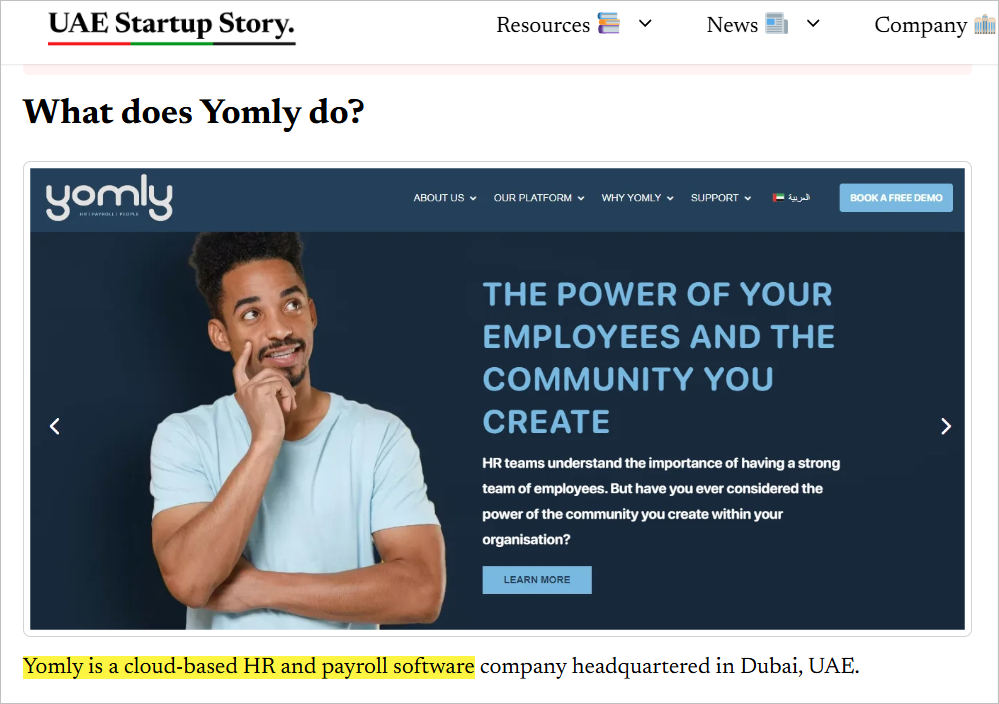
Take Yomly as an example. Its brand positioning remains consistent across its website and social media channels.
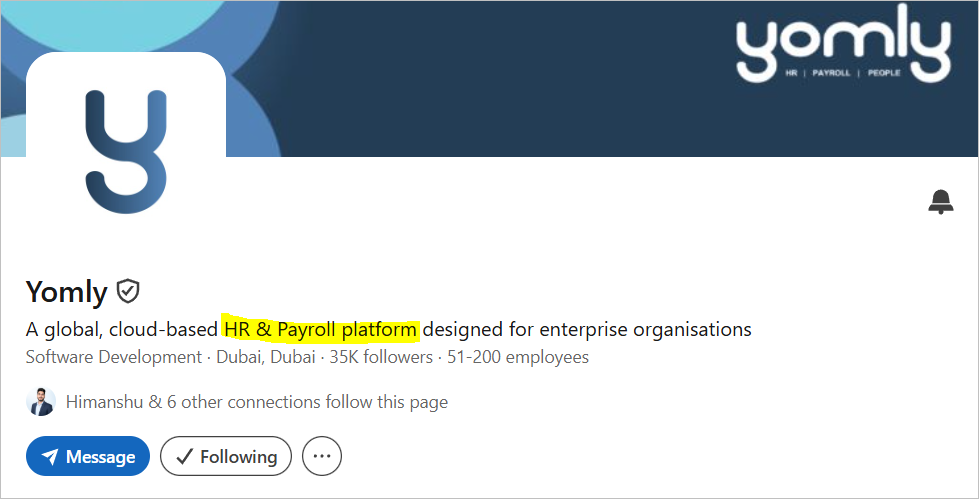
LinkedIn Bio positioning Yomly as a cloud-based HR-Payroll platform
The same brand positioning is seen on the website’s homepage:
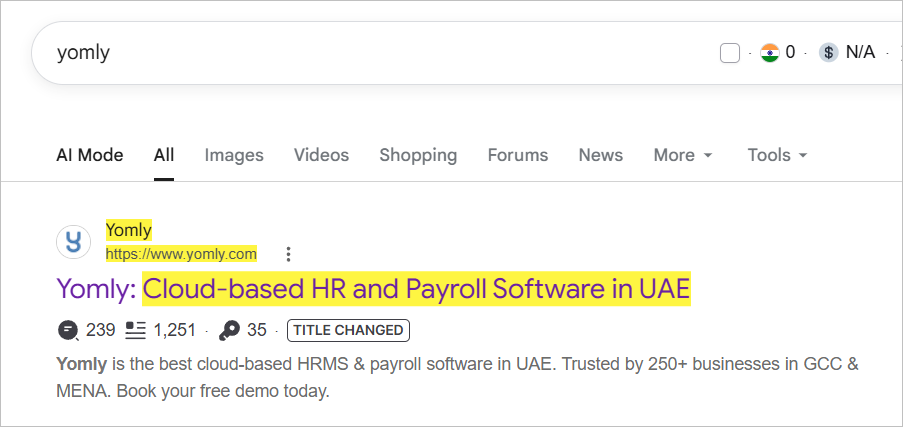
Here’s another example of a similar brand description for Yomly in a PR article.
7. Build the brand outside its own website
Traditional SEO often focuses heavily on owned pages and backlinks.
AI discovery creates a wider environment where brand mentions across third-party sources can influence how a company is understood and surfaced.
We would identify the platforms that matter within the SaaS category. These could include review websites, industry publications, Reddit, Quora, LinkedIn, YouTube, directories, comparison websites, news coverage, and other relevant communities.
The objective would not be to create artificial mentions everywhere.
We would build genuine evidence of expertise, customer experience, product value, and category relevance across sources that buyers and AI systems already use.
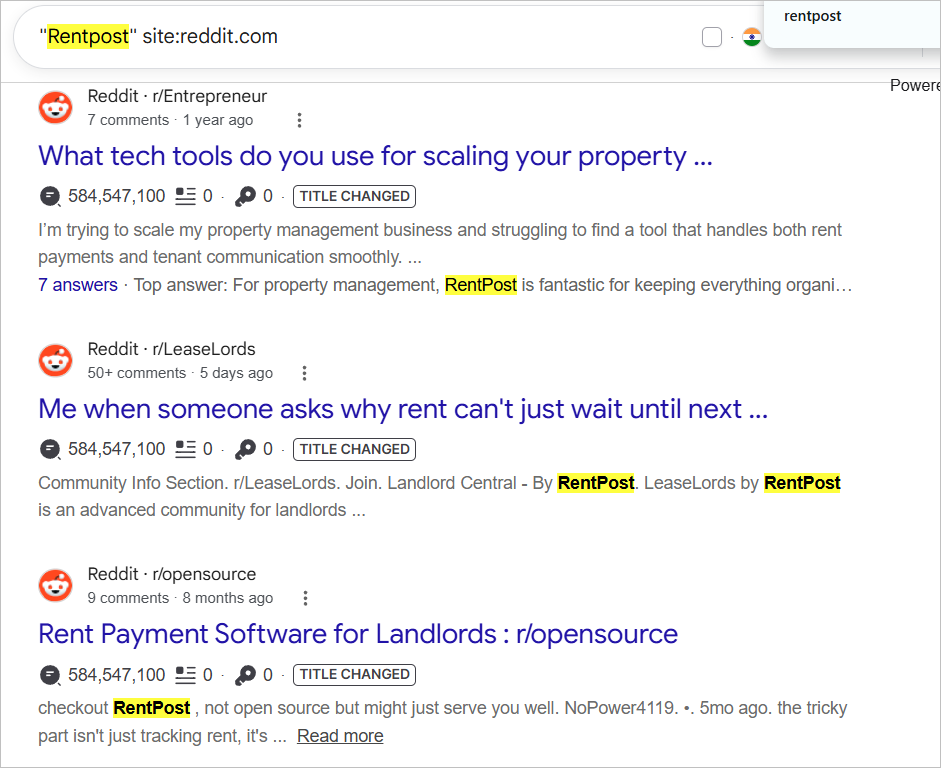
You can Google the following queries to understand the brand presence outside of your website:
- [Your site name] site:reddit.com
- [Your site name] site:Quora.com
- [Your site name] site:linkedin.com
These queries will show you how people discuss your brand on other UGC platforms and whether the sentiment is positive or negative.
An example of checking Reddit discussion about the brand:
8. Create linkable assets that earn authority and demand
Instead of setting a monthly backlink target, create assets that people have a reason to reference. Invest around 10% of your content effort in original research, industry reports, benchmarks, surveys, statistics, calculators, templates, datasets, or free tools.
Build assets that keep earning links
Turn the findings into supporting blog posts, charts, and social content that link back to the main asset. Make the asset easy to reference with clear data and useful insights. Then promote it to relevant publishers, communities, and industry websites.
Track which assets earn backlinks and referring domains, and update the strongest ones with fresh data. This creates a link building flywheel that can continue earning links without constant outreach.
Here are some of most effective linkable asset types for a SaaS brand:
| Linkable asset type | What a SaaS company can create |
| Original research | Survey customers or industry experts and publish the findings |
| Statistics pages | Curate industry statistics with original insights |
| Free calculators | Build tools for ROI, costs, savings, or other useful calculations |
| Annual reports | Publish yearly reports covering industry trends and data |
| Free tools | Build simple tools that solve a specific audience problem |
| Original studies | Analyze customer or product data to uncover useful trends |
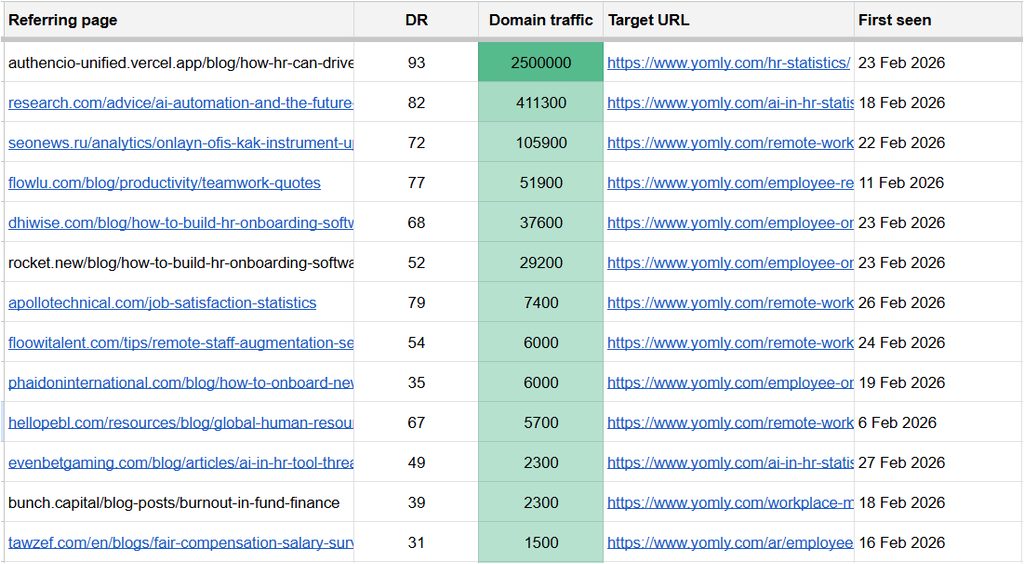
Following the exact linkable asset content strategy, we acquired 20+ high-quality monthly backlinks for Yomly:
👉 Why off-page SEO is not only about link building anymore
9. Measure organic growth by pipeline, not traffic alone
Traffic would remain useful, but it would not be the final KPI.
We would connect organic performance with demo requests, free trials, signups, qualified leads, sales opportunities, and revenue where the tracking setup allows it.
We would also look at lead quality.
If one page generates 10,000 visits but attracts users outside the target market, while another generates 500 visits and produces 20 qualified opportunities, the second page may be far more valuable.
How long does SaaS SEO take?
SaaS SEO typically takes 3 to 6 months to generate noticeable results and 6 to 12 months to build meaningful organic growth. However, a new website with no SEO history usually needs more time than an established site that has been running for years with hundreds of pages and quality backlinks.
However, the starting point of your SEO campaign matters. An established SaaS website already has some authority, search history, indexed content, and backlinks to build on. A new website needs to establish these signals from scratch, which can make the early stages slower.
| Timeline | What to expect |
| 0 to 3 months | Audit, technical fixes, keyword mapping, content updates, early ranking movement |
| 3 to 6 months | More impressions, improved rankings, growing organic traffic |
| 6 to 12 months | Stronger commercial rankings, qualified leads, trials, and demos |
| 12+ months | Compounding traffic, stronger authority, and greater pipeline contribution |
How much does SaaS SEO cost end to end?
SaaS SEO typically costs AED 7,000 to AED 14,000 per month for an end to end SEO program, depending on the website’s size, competition, current SEO performance, and the level of work required.
This can include SEO strategy, technical optimisation, keyword research, content planning and updates, internal linking, authority building, conversion-focused pages, reporting, and AI brand positioning. Newer websites may need more foundational work, while established SaaS websites can focus more heavily on scaling content, commercial pages, and authority.