
Welcome to the first issue of The AI SEO Digest.
Search has changed. People ask AI now, and AI answers.
This week, the clearest lesson comes from a real test. Three AI models shopped the same catalogue, asked the same question, and picked three different winners.
There is no single AI No.1 to rank for anymore.
Here are the 5 most important AI SEO updates from the last few days. We have put real tests first.
Brought to you by ASAD
The AI SEO Digest is curated by ASAD (asad.ae), the AI SEO agency.
We help brands get cited in ChatGPT, Google AI Overviews, Perplexity, Claude, and Gemini. We also work on technical SEO, content strategy, and digital PR.
1. Three AI models shopped the same Shopify catalogue and picked three different winners
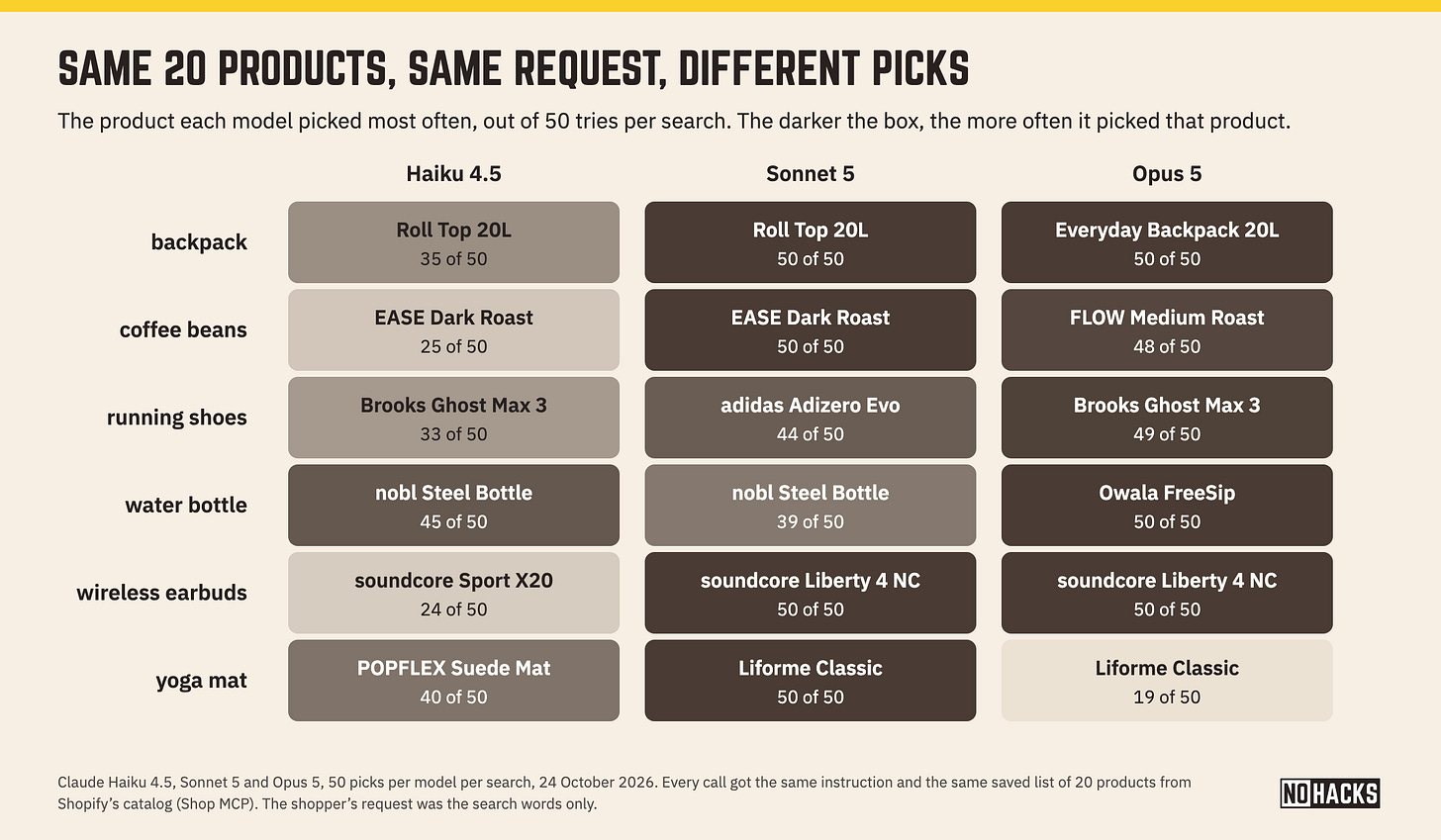
The test used the same 20 products from Shopify, the same request, and 50 picks per model per search.
Three Claude models took part: Haiku 4.5, Sonnet 5, and Opus 5. That is 1,980 picks in total across the 3 models.
There was also a sunscreen test (600 picks) and 8 skincare list-order tests (480 picks).
This matters because AI shopping is no longer a search list. The model reads your product data and picks a winner for the shopper.
So a product can lose even if it ranks well in normal search. That is why the same catalogue gave three different winners.
On the 6 product searches, the three models’ most-picked product matched in none.
Sonnet’s top pick took 94% of its picks on average. Opus took 89%, and Haiku took 67%.
Adding “under $25, for oily skin” moved all three models off the $48 top sunscreen in 298 of 300 picks. The new winner was a $20 sunscreen.
Moving a product from first to last in the list cut Haiku’s picks of it from 28 to 11 of 80. Sonnet moved from 25 to 12 of 80, and Opus from 23 to 9 of 80.
Why it matters:
There is no single AI “No.1” to rank for. The same catalogue, the same question, a different winner in every model.
So test across models. And make your product facts, reviews, and feed accuracy exact, because that is what the models read.
👉 Read more about the Shopify AI shopping test
2. We opted out of Google AI search — here’s what happened
Zyppy opted out of Google’s AI search features for 28 days, from 1 to 29 Sep 2026. Then it opted back in.
AI search here means the AI answers in Google, like AI Overviews. When those answers disappear, your page does not just get replaced by a blue link.
The test shows how much visibility now lives inside the AI answer, not just in the blue links.
AI search impressions fell to zero within an hour of opting out. Before that, they were running at 500 to 1,000 a day.
The author estimates an AI search click-through rate of about 0.9%. That is roughly double the site’s 0.4% organic rate.
AI search accounted for about 21% of total clicks. That rises to 23% if you include a small “halo effect” from users it also introduced to the site.
The site still ranked #1 organically while it was completely gone from AI features.
Why it matters:
This is the first clean before-and-after number for AI Overviews and AI Mode as a click source, and it is high.
And opting out removes citations entirely, even at No.1 organically. One caveat: this is a single site and does not prove opting out helps revenue.
👉 Read more about the Google AI search opt-out test
3. GEO isn’t a distraction — AI influence doesn’t show up in referral data
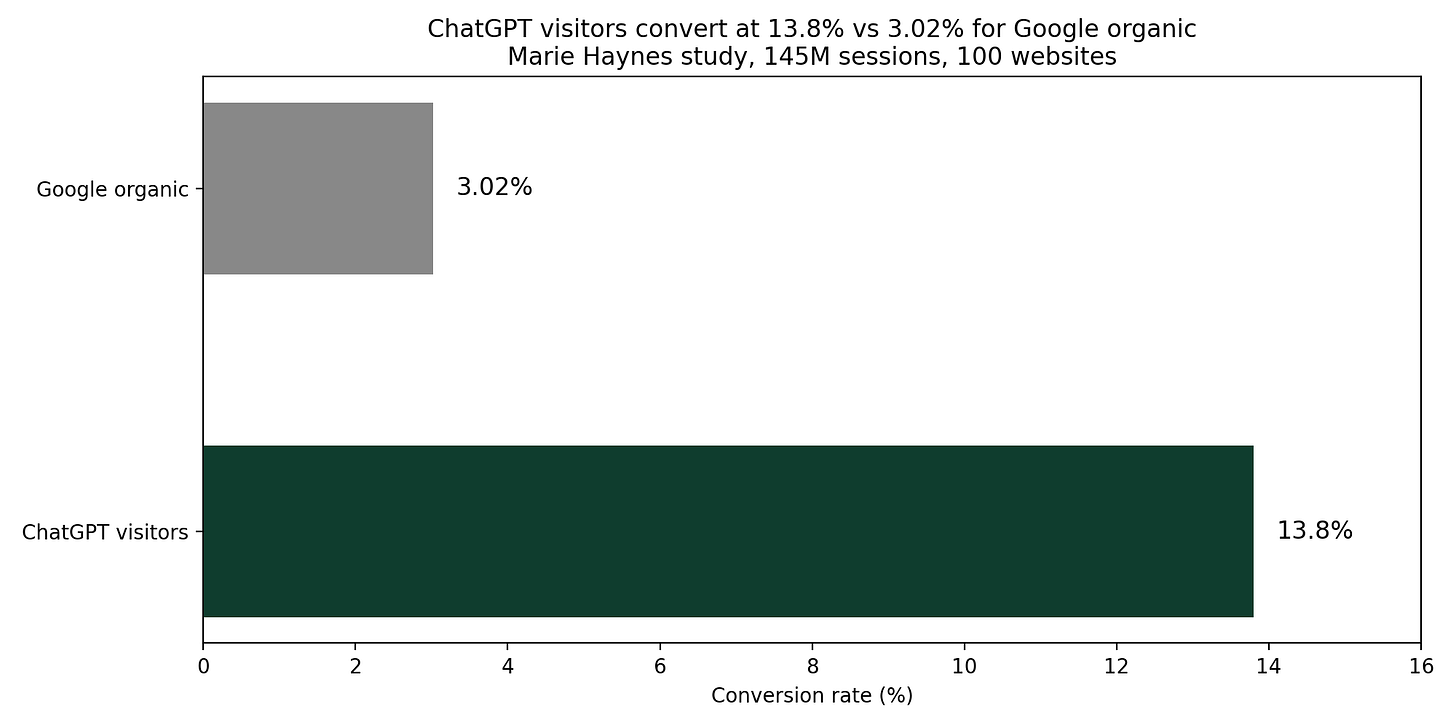
Marie Haynes looked at 12 months of GA4 data, across 100 websites and 145 million sessions.
The debate is simple. One side says AI traffic is too small to matter, so skip GEO.
The other side says that misses the point, because people now decide inside the AI chat and only click after they have already chosen.
ChatGPT sessions were 0.62% of Google organic volume. All LLMs together were 0.73%.
But ChatGPT visitors converted at 13.8%, against 3.02% for Google organic. That is about 4.5 times higher.
Google still drove 96.5% of total conversions, 27 times more than all LLMs combined.
A follow-up study looked at 108 million sessions, from 1 Jan to 2 Nov 2026, across 57 websites. Total LLM traffic was still 0.73% of Google organic volume.
Why it matters:
AI traffic is tiny, but its visitors convert at about 5 times the rate. So judging GEO only by session volume misses the point.
Buying decisions are being made inside the AI answer, not after the click.
👉 Read more about GEO and AI referral data
4. Google AI Overviews for brands move to the right column

Google moved AI Overviews for many brand-related keywords to the right-hand column on desktop. That is where the knowledge panel used to be.
A brand search is when someone searches for a company name, like Apple or Zillow. Until now, the right-hand column has been brand-controlled, showing logos, facts, and links.
Now that space is used for an AI written summary instead, so the AI version of your brand story can be the first thing you read.
Before, they appeared at the top or in the middle of the main results.
Examples include Apple, Zillow, Coca-Cola, Google itself, and Search Engine Roundtable. Chris Long spotted it on 2 Nov, and David McSweeney noted it on 31 Oct.
Google has not announced it. It has not said if this is a test or permanent.
All published examples are US desktop so far.
Why it matters:
For brand searches, Google’s own AI summary now sits where the brand-controlled knowledge panel used to sit.
And its own site may no longer be the first thing a searcher reads about it.
👉 Read more about Google AI Overviews for brands
5. OpenAI is building ChatGPT Tools for Business — Analytics & Citations

OpenAI is developing a Search Console-like tool for businesses in ChatGPT.
Right now, businesses have no official way to see when ChatGPT mentions them, or how often people click through to their site.
Businesses could claim their listing, track mentions and clicks, and update their product information.
A verified business will be able to claim its presence. It will also be able to track how often it is mentioned, and how often users click through to its website.
It will show impressions and clicks on links to its website, in a daily chart. Businesses will also be able to see citations, references, and sources.
A business agent will be able to answer questions with context the business controls. It will not share prompt, user, or competitor data.
Why it matters:
This is the first first-party ChatGPT measurement for brands. It is impressions and clicks from OpenAI itself, not third-party estimates.
If it launches, GEO work can finally be proven with OpenAI’s own data.
👉 Read more about ChatGPT Tools for Business
One tactic for this week
Test the same 5 prompts across ChatGPT, Perplexity, and Google AI Overviews. Test across models too, if you can.
Do not optimise for one “winner”. Check whether AI retrieves and cites your site, or a competitor, for each prompt.
Fix retrieval first. Then front-load the answer, because 44.2% of ChatGPT citations come from the first 30% of a page.
What ASAD does, and how our approach is different
ASAD is the AI SEO agency behind this newsletter. We help brands get seen, cited, and chosen in ChatGPT, Google AI Overviews, Perplexity, Claude, and Gemini.
Most SEO still optimises for rankings and clicks. That is not enough anymore, because people now get their answer inside the AI chat and may never click at all.
Our approach starts with AI visibility, not just rankings. We check where your brand appears in AI answers, where it is missing, and what the AI is getting wrong about you.
Then we fix the foundations that decide those answers. That means technical SEO, clear content the AI can retrieve and cite, and digital PR that builds trust in the sources AI models use.
We test across models and prompts, not just one tool. Because as this issue shows, the same question can give a different winner in every model.
The result is simple to measure. More mentions, more citations, and more people choosing your brand inside AI search, not just more traffic.
Get your ASAD AI Visibility Report
Want to know where your brand stands in AI search?
Get your free ASAD AI Visibility Report. We check whether ChatGPT, Perplexity, Gemini, and Google AI Overviews mention and cite your brand. And we show you what to fix first.
Request yours at asad.ae