
Walmart is the brand ChatGPT names most. Plus: rewriting YouTube descriptions lifted AI retrievals 359%, why being mentioned in 98% of AI answers is not enough, OpenAI launches real ChatGPT click data for businesses, and Google puts Gemini 4 Hydrogen in charge of AI Mode. Five real tests and Google updates, curated for AI SEO.
Welcome to the second issue of The AI SEO Digest.
This week, the clearest lesson is that being named by AI is only the start. Walmart wins on mentions, a single company wins on mentions and still loses sales, and a better description can lift retrievals without a single new video.
Here are the 5 most important AI SEO updates from the last few days. We have put real tests first.
Brought to you by ASAD
The AI SEO Digest is curated by ASAD, the AI SEO agency.
We help brands get cited in ChatGPT, Google AI Overviews, Perplexity, Claude, and Gemini. We also work on technical SEO, content strategy, and digital PR.
1. Walmart is the brand ChatGPT names most
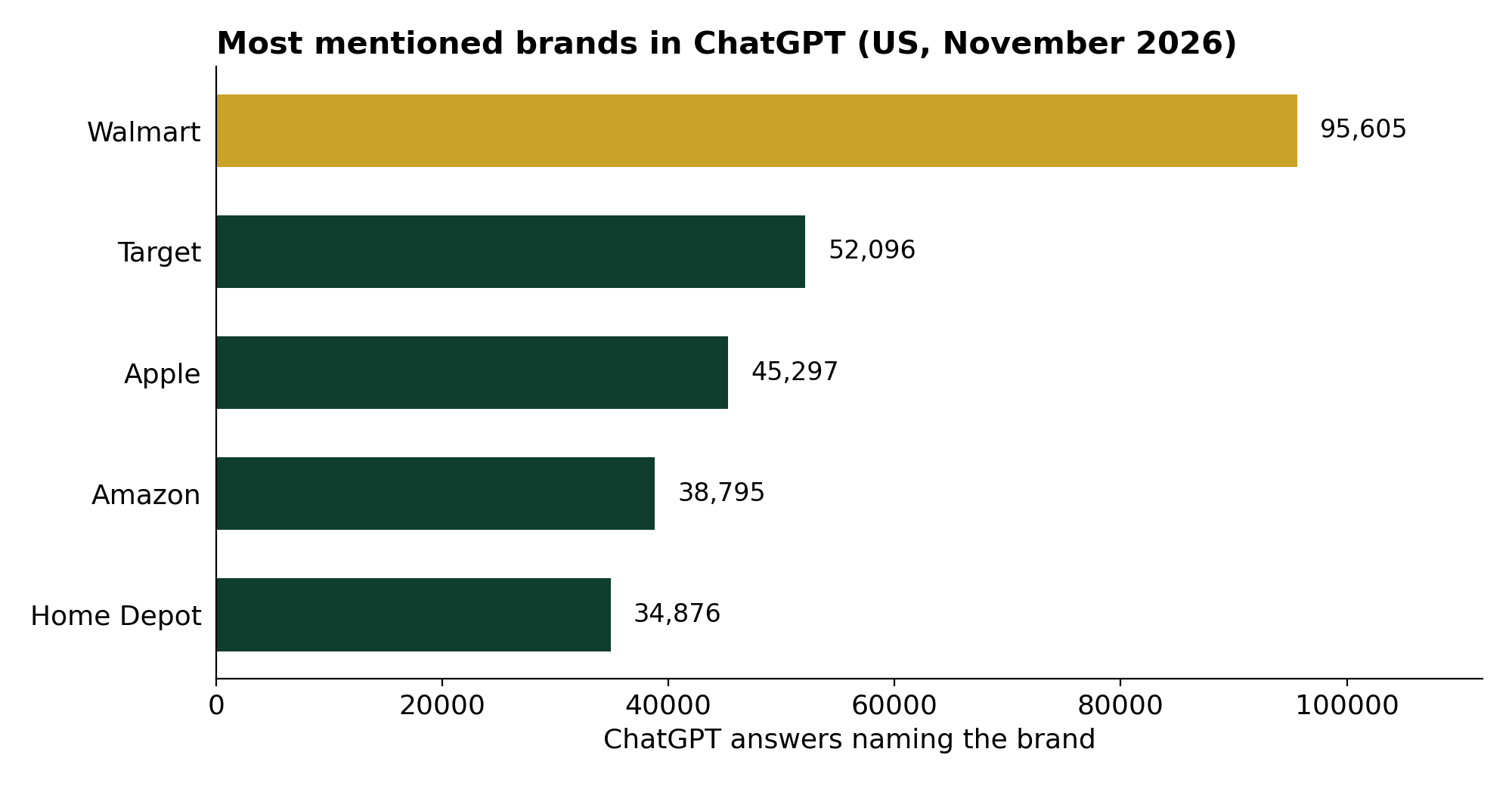
Ahrefs counted brand mentions across 5,516,381 United States ChatGPT answers in its Brand Radar index, covering every topic in November 2026.
Walmart was named in 95,605 answers, or 1.73%. That is almost twice as many as Target in second place, with 52,096 answers.
Apple was third with 45,297 answers, Amazon fourth with 38,795, and Home Depot fifth with 34,876. Stores took 6 of the top 10 spots.
Retailers hold 23 of the top 100 spots and 35% of all mentions. Carmakers hold 15 of the top 100 spots and 14% of mentions.
The pattern is simple. Stores win when people ask where to buy something, and product brands win when people ask what to buy. Walmart is ChatGPT’s default answer to where to buy something cheaply, while Apple is named mostly for iPhone and iPad questions, not for its stores.
Why it matters:
AI visibility is won at the level of the question type, not the homepage. A brand can rank well on Google and still be invisible in ChatGPT if it is not tied to a buying question.
👉 Read more about the most mentioned brands in ChatGPT
2. Rewriting YouTube descriptions lifted AI retrievals 359%
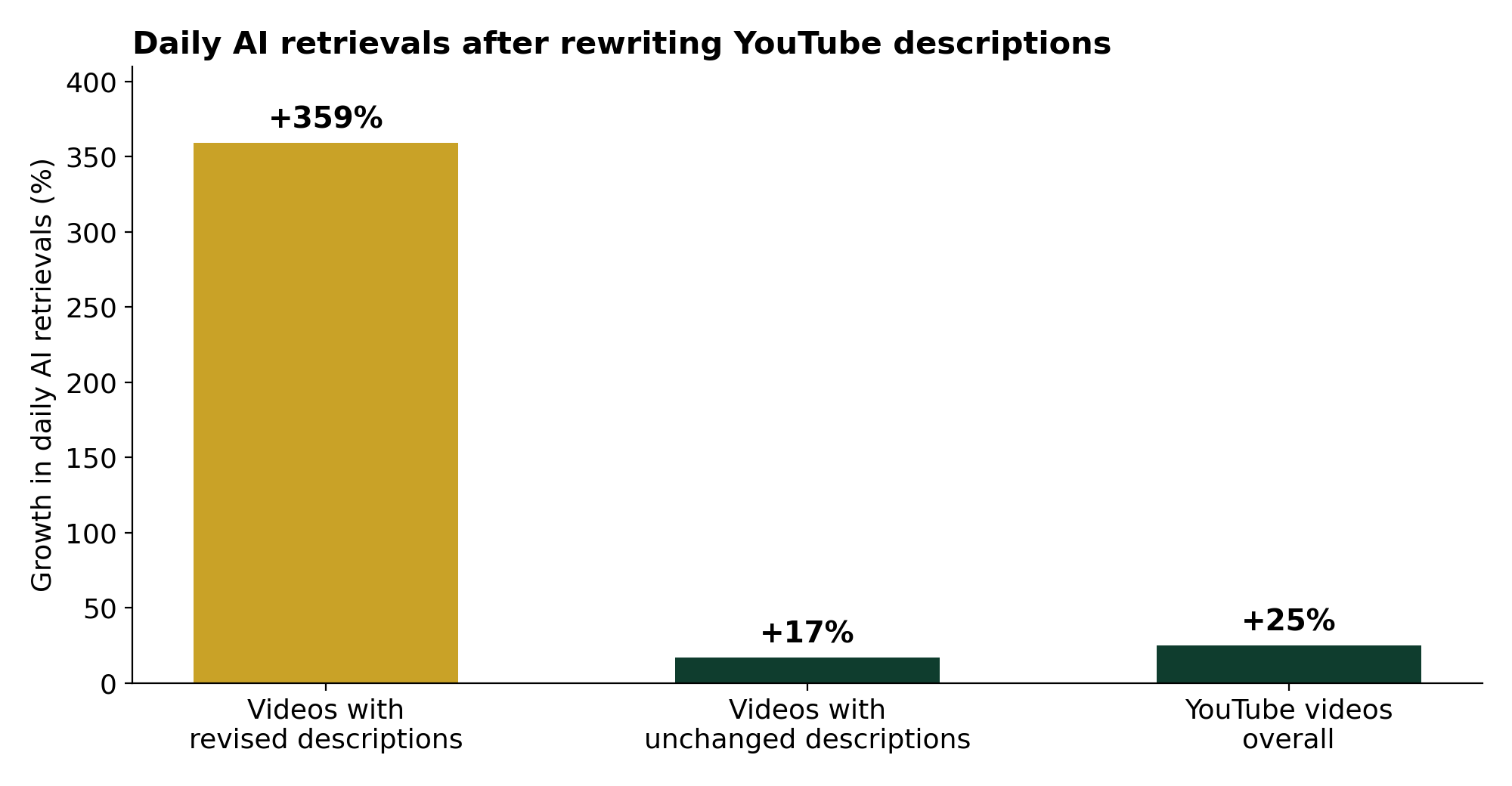
David Konitzny and his team rewrote the descriptions of selected YouTube videos with more detailed, structured text. They changed nothing else. The videos themselves stayed the same.
Daily AI retrievals rose 359% for the videos with revised descriptions. Unchanged videos rose 17%, and YouTube videos overall rose 25%.
The lift showed up on every surface they tracked. Google AI Overviews rose 293% against 27% overall, and Google AI Mode rose 129% against 11% overall.
Descriptions can run to 5,000 characters, yet most teams use only a fraction of that space. Konitzny is clear that this does not prove longer descriptions alone caused the lift, and he published no raw retrieval totals, no video count, no test duration, and no prompt set.
Why it matters:
Retrieval responds to structured context in places most teams ignore. AI visibility is often won by making existing content easier for machines to understand, not by creating more content.
👉 Read more about the YouTube descriptions test
3. A brand can be mentioned in 98% of AI answers and still lose the sale
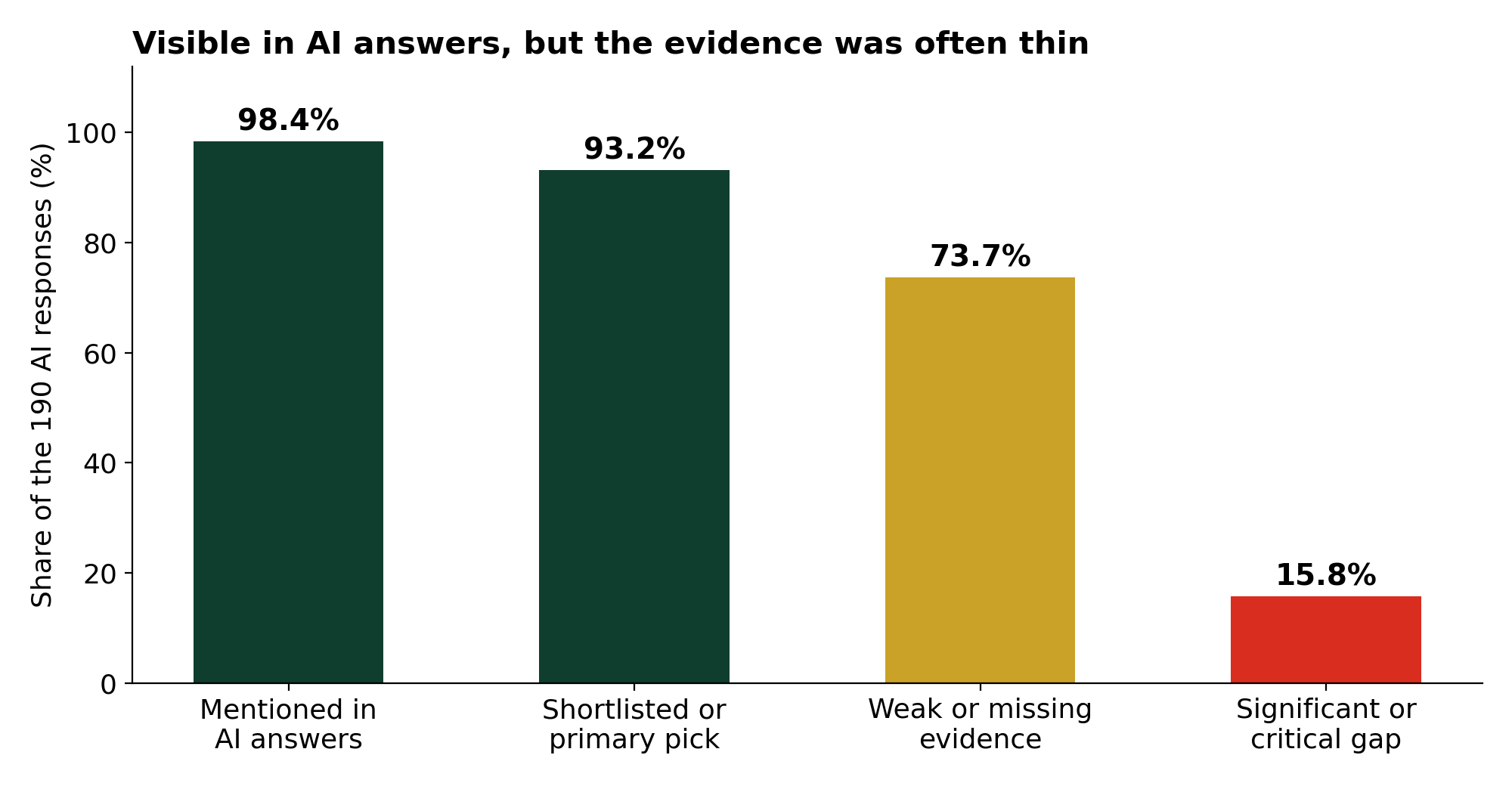
Bill Hunt tested a real company whose lead pipeline was shrinking even though its AI visibility scores looked excellent. He ran 38 detailed, criteria based prompts across 5 AI surfaces, giving 190 responses.
The brand was mentioned in 98.4% of responses and was a primary recommendation or shortlisted option 93.2% of the time. On a normal visibility scorecard, that would look like a win.
Then Hunt checked the same answers against the decision criteria in the prompts, things like integrations, workflows, regulatory requirements, and outcomes. In 73.7% of responses, the evidence for important claims was weak or missing, and in 15.8% there was a significant or critical gap on a decision criterion.
The capability often existed. The evidence for it did not, or it was scattered across pages so the AI could not connect it. This was a single company test, and the company was not named.
Why it matters:
Being named is only the first gate. As buyers ask deeper questions, AI needs decision grade evidence, like pricing, integrations, proof of outcomes, and third party corroboration. Brands that only publish parity content get dropped mid conversation.
👉 Read more about visibility and evidence in AI answers
4. OpenAI launches Businesses in ChatGPT, with real click data
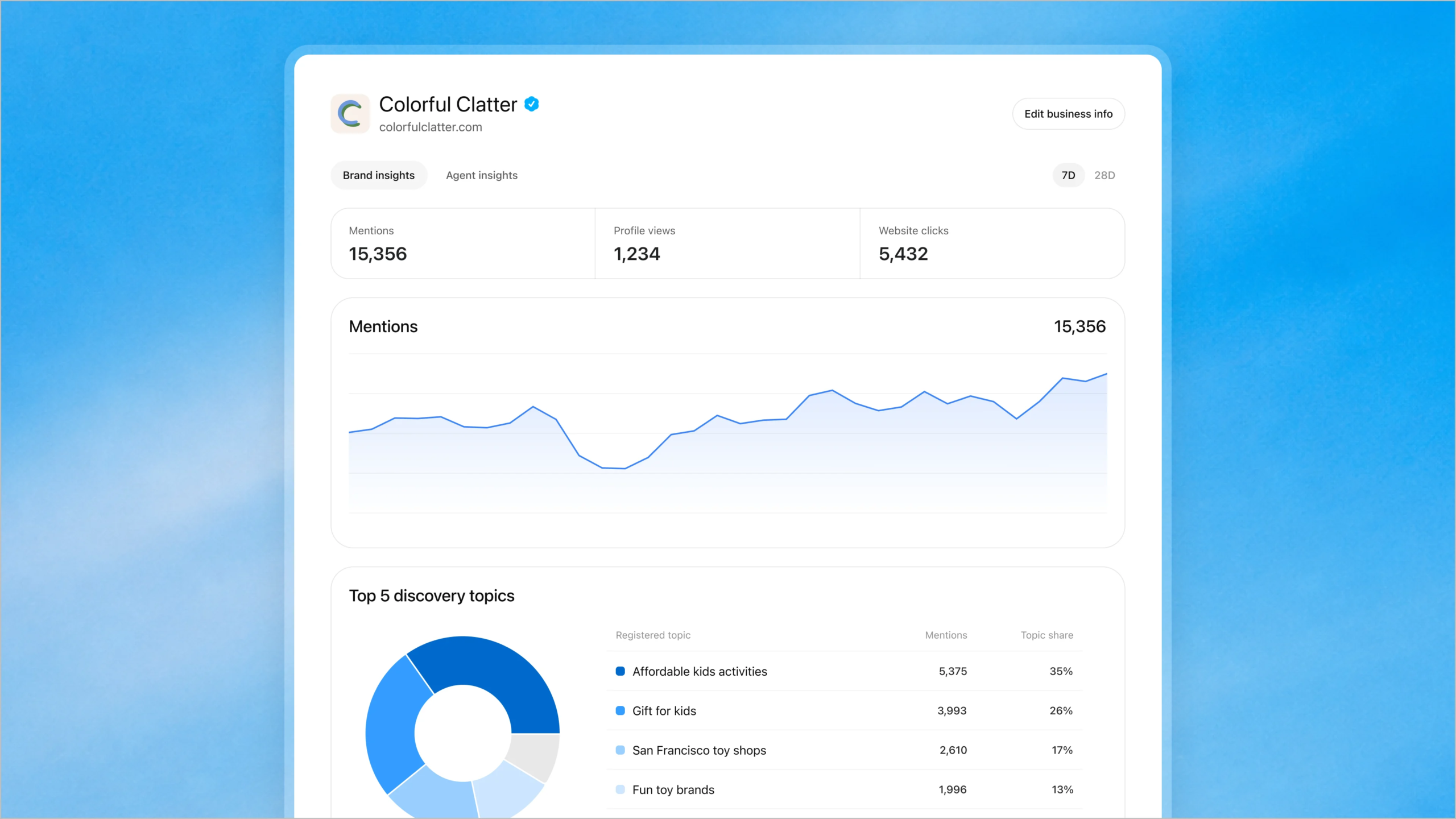
OpenAI has launched Businesses in ChatGPT in beta. This is the tool Issue #1 reported as in development, and it is now live.
Businesses can claim a profile in ChatGPT, correct their details, add product feeds with pricing and availability, and see how often ChatGPT mentions them and how many clicks reach their site. The hub also shows profile views and discovery topics, the common themes in conversations where a site is cited.
Insights cover the past 28 days. Business Agents start with eligible ecommerce and online service businesses in the United States only, and a business can verify by phone or text to its business number, or by DNS record.
OpenAI says 1.2 billion people use ChatGPT each week. It also says claiming a profile does not guarantee higher placement or sales, and its own tooltip warns that clicks do not confirm website visits or conversions.
Why it matters:
This is the closest thing ChatGPT has to a business profile plus Search Console. AI visibility turns from a third party estimate into first party measurement, with the caveat that claiming a profile does not make ChatGPT recommend you more.
👉 Read more about Businesses in ChatGPT
5. Gemini 4 Hydrogen is now the default model in AI Mode
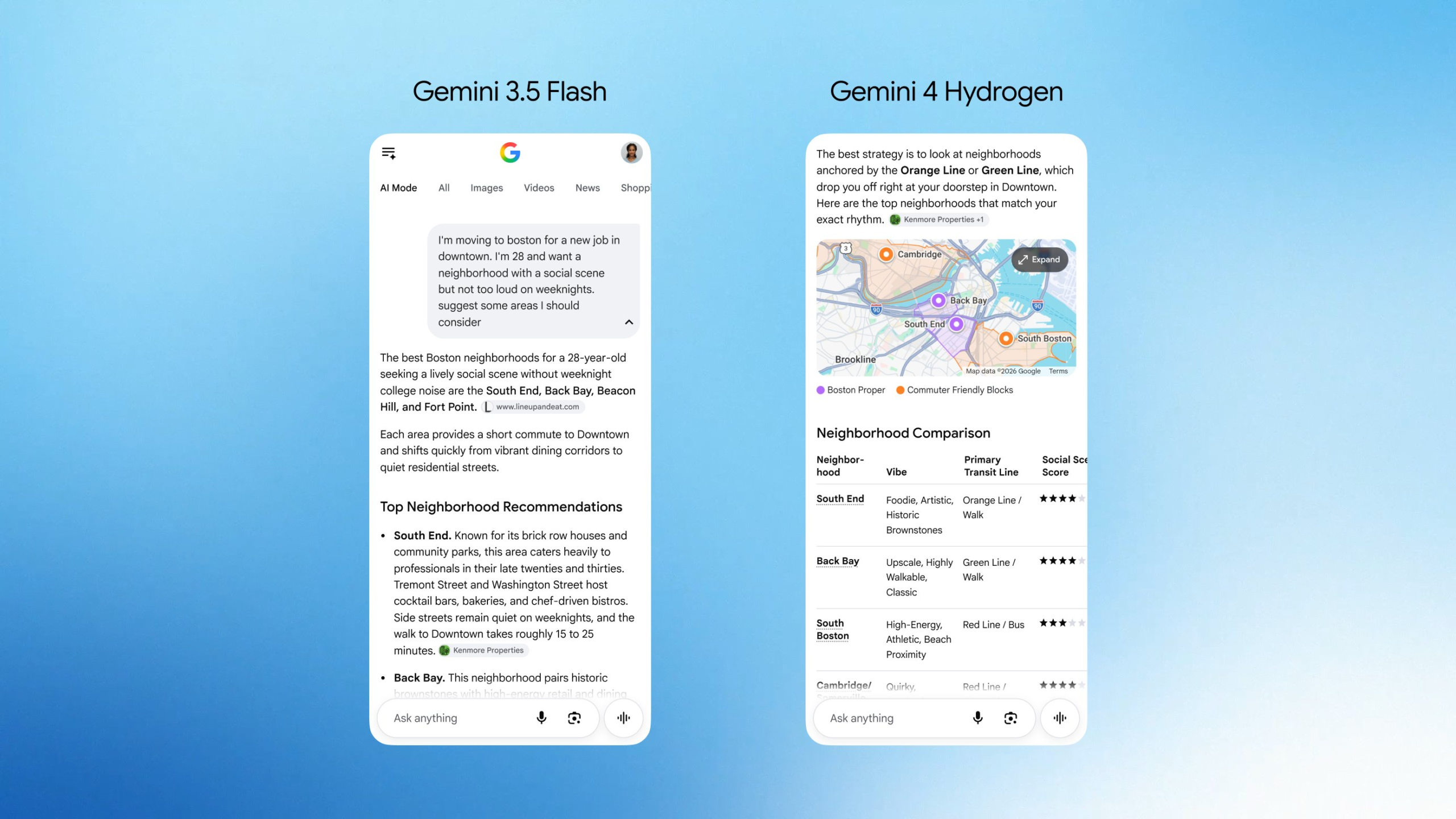
Google has made Gemini 4 Hydrogen the default model in AI Mode for all users worldwide. It is also used for the hardest AI Overview questions.
Hydrogen replaces Gemini 3.5 Flash, which had been the AI Mode default since May 2026. Two days earlier, Google had put Gemini 4 Carbon in AI Mode for AI Ultra subscribers only.
Google says Hydrogen handles multi part and typo filled queries better, with improved query fan out, and connects users to a broader range of helpful links than before, including sites users may never have found themselves. It also promises more visual answers, comparison tables, and nuanced answers in all AI Mode languages.
Google published no counts for links, sites, or traffic, and it has not said which AI Overview questions count as hardest. The switch landed two days into the November core update, which began on 10 November and was still rolling out.
Why it matters:
Any AI Mode or AI Overview citation data from this month now spans a model change on 12 November, inside a core update. Log both dates and compare before and after, rather than reading November as one change.
👉 Read more about Gemini 4 Hydrogen in AI Mode
From the ASAD blog
We tested Google AI vs ChatGPT results and found 61% overlap.
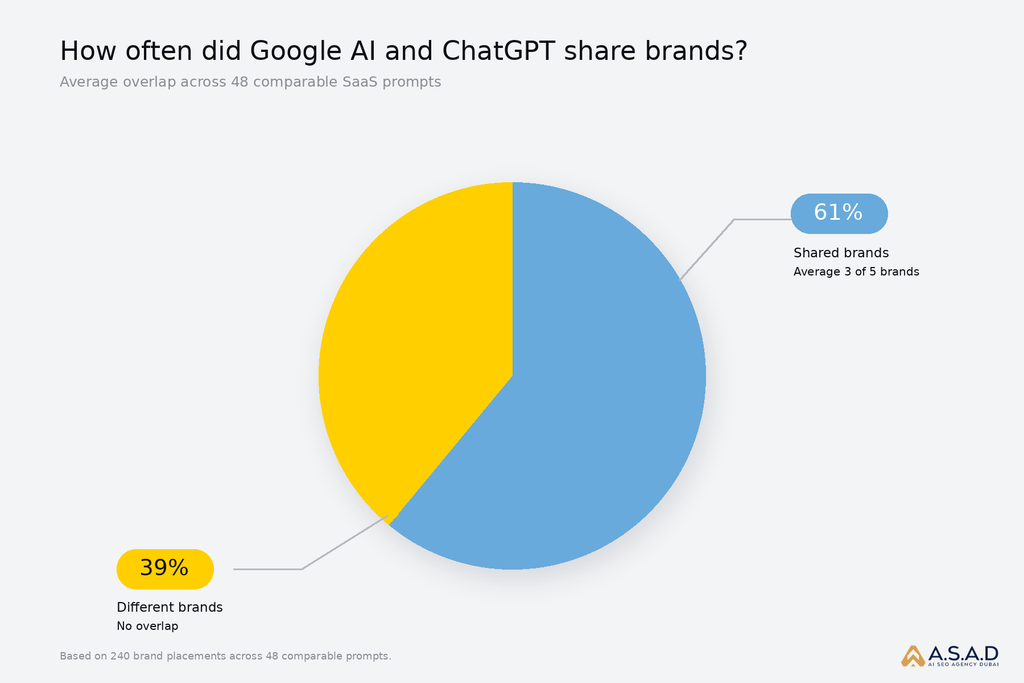
Our own team ran the same 50 commercial prompts across 10 SaaS categories on Google AI Overviews and ChatGPT. The two platforms shared 61% of their brand recommendations, or 146 of 240 placements, and on average they named 3 of the same 5 brands.
But the top pick was shared in only 22 of 48 comparable prompts, or 46%. Google AI put Asana or Trello first in project management searches where ChatGPT picked ClickUp, so position matters as much as presence.
Overlap ranged from 36% in HR and payroll to 73% in customer support. A single overall score hides those gaps, so track visibility at category level.
And 125 of 220 unique companies appeared on only one platform, 62 on Google AI only and 63 on ChatGPT only. This was a single day snapshot on 11 November, using SaaS prompts only, with India set as the search location for Google AI, so repeat the test over time rather than treating it as a fixed result.
👉 Read more about the Google AI vs ChatGPT study
One tactic for this week
Pick 5 buying prompts your customers actually ask, and run them across ChatGPT, Perplexity, and Google AI Overviews. Note two things for each prompt: whether your brand is named, and whether the AI can back its claim about you with real proof.
Then fix one evidence gap this week. Add or sharpen one page that proves a claim with numbers, a customer quote, or a link to your docs, and make sure your key pages and your best video descriptions carry the same structured facts.
Log 12 November in your tracking sheet as the Gemini 4 Hydrogen change, so you can compare your citations before and after it.
What ASAD does, and how our approach is different
ASAD is the AI SEO agency behind this newsletter. We help brands get seen, cited, and chosen in ChatGPT, Google AI Overviews, Perplexity, Claude, and Gemini.
Most SEO still optimises for rankings and clicks. That is not enough anymore, because people now get their answer inside the AI chat and may never click at all.
Our approach starts with AI visibility, not just rankings. We check where your brand appears in AI answers, where it is missing, and what the AI is getting wrong about you.
Then we fix the foundations that decide those answers. That means technical SEO, clear content the AI can retrieve and cite, and digital PR that builds trust in the sources AI models use.
We test across models and prompts, not just one tool. Because as this issue shows, the same question can give a different winner in every model.
The result is simple to measure. More mentions, more citations, and more people choosing your brand inside AI search, not just more traffic.
Get your ASAD AI Visibility Report
Want to know where your brand stands in AI search?
Get your free ASAD AI Visibility Report. We check whether ChatGPT, Perplexity, Gemini, and Google AI Overviews mention and cite your brand. And we show you what to fix first.
Request yours at asad.ae